In August, Can-Am dropped the MSRP on its 2026 Pulse and Origin electric motorcycles by $3,000 — the Pulse now starts at $10,999, the Origin at $11,499. Good news for the next customer who walks in. A very different kind of news for the dealer holding 2025 units on a floorplan line, the customer who financed one at last year's price, and every trade-in valuation that just quietly moved.
That is electric powersports in one memo. The bikes are good. The engineering is real. The growth is real — LiveWire moved 267 electric motorcycles last quarter, up 386% from a year ago. And the math underneath is still brutal: that same quarter cost LiveWire $18.2 million. Two of the category's best-known independent brands, Cake and Energica, went bankrupt within nine months of each other — and both had to be rescued by outside investors to keep existing.
The industry keeps having the wrong argument about electric powersports. It is not a debate about whether the product is ready or whether riders want it. For a dealer, it is a much narrower question: can you desk, finance, protect, and resell this unit without the deal math blowing up in your face? Right now, at most stores, the honest answer is "not with the process we have."
This piece is the deal-math case: what EV units actually do to trade values, financing, F&I gross, and inventory risk — and the playbook for selling the future without donating your margin to it.
The Growth Is Real. So Is the Math
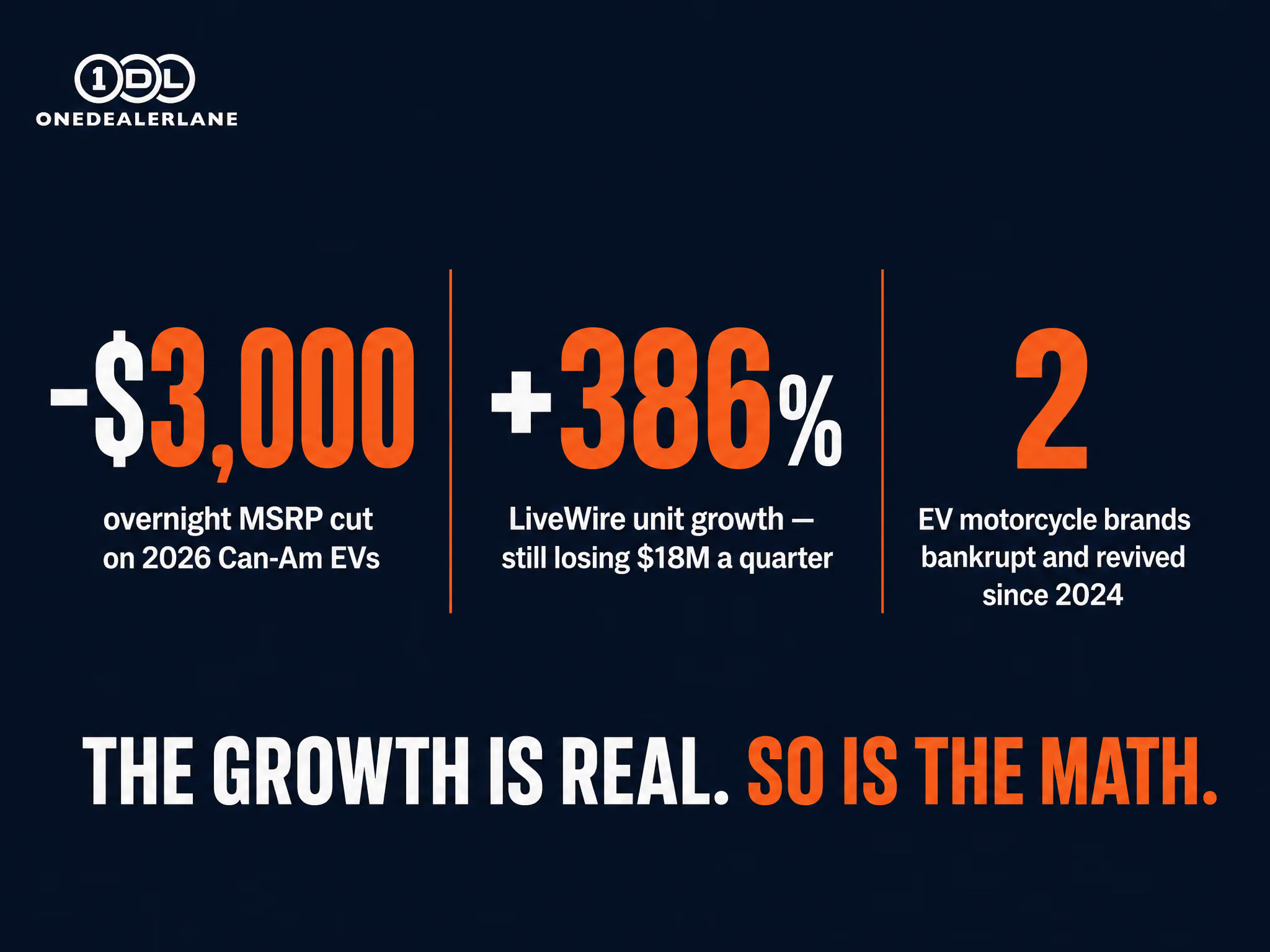
Start with both truths, because most coverage only tells you one. Truth one: electric powersports is growing. LiveWire sold 267 electric motorcycles in Q2 2026 against 55 a year earlier — a 386% jump — with revenue up 55%, a new S4 Honcho platform in production, and an acquisition (Dust Motorcycles) pushing into electric off-road. BRP launched the 2026 Can-Am Outlander Electric, carrying electrification into the ATV segment — core dealer territory, not a niche experiment. Zero returned to the dirt-bike market with the XB and XE. Auto Finance News framed the sector plainly this summer: real funding, real technology — and an uphill path in the U.S. market.
Truth two: the economics remain unforgiving. LiveWire's growth quarter still came with an $18.2 million net loss. Cake, the Swedish brand that once defined premium electric off-road, filed for bankruptcy in February 2024 and survives only because a Norwegian retail group bought the brand out of the wreckage. Energica — 75% controlled by an American fund that itself ran out of road — entered judicial liquidation in October 2024 and was revived by Singapore investors the following year. These are not obscure startups; they were the category's flagship independents.
Why should a dealer care about OEM income statements? Because a manufacturer losing money on every unit has exactly two levers: raise prices or cut them to chase volume. In EV powersports, the market has answered which lever gets pulled. And every pull lands on your showroom floor, whether you were consulted or not.
The dealer takeaway from the macro story is not "avoid electric." Units are coming to your lineup either way — ask any Can-Am dealer looking at the Outlander Electric in their 2026 book. The takeaway is that the volatility lives on the value side of the deal, which means the stores that survive it will be the ones whose deal process prices that volatility in.
The $3,000 Memo: What a Price Cut Does to Your Floor
Rider Magazine reported the Can-Am cut in a single sentence: 2026 Origin and Pulse models are $3,000 cheaper than 2025's MSRP. Now walk that sentence through a dealership.
First, your inventory. Any 2025-model EV on your floor just became a unit you will almost certainly sell below the number you floored it at — while the floorplan clock keeps running. Black Book's Q2 2026 powersports update describes a stabilizing floorplan rate environment, which helps, but stabilization does not refund a $3,000 markdown handed down from the OEM.
Second, your trades. The customer who bought an electric motorcycle at 2024 or 2025 pricing is now structurally upside down. RideApart put it bluntly in a headline about LiveWire's repricing: anyone who bought before the price drop is getting screwed on resale. LiveWire cleared its remaining first-generation One inventory at $16,499 — bikes that originally listed well above $20,000 — and rebuilt its lineup around roughly $12,000 S2 models. When new MSRPs fall, used values do not politely hold their ground; they fall further, faster. That trade is walking into your lane, and your desk has to put a number on it that is honest without killing the deal.
Third, your customers' equity math. Steeper, less predictable depreciation changes what a responsible deal structure looks like. A protection conversation that is optional garnish on a Sportster deal is structural on an EV deal: GAP stops being a nice-to-have when the value curve looks like a ski slope, and value-protection products earn their keep. This is the part of the EV story almost nobody is writing for dealers — the F&I menu is where EV deal risk actually gets managed.
One more wrinkle: book values themselves are young here. J.D. Power publishes values for the 2026 Can-Am Pulse, but thin used-transaction volume means wider error bars than the ICE units your appraisers have priced for twenty years. When the book is soft, your process — documented appraisals, real market checks, disciplined desking — is the only thing standing between you and a five-figure education.
No Credit Crutch, Uneven Lending
Automotive EVs spent years riding federal purchase credits. Electric motorcycles never really got that ride: two-wheelers were left out of the Inflation Reduction Act's headline consumer incentives, as RevZilla documented, leaving an inconsistent patchwork of state programs and OEM promotions. Can-Am is filling the gap itself with 0.99% pre-order financing — which tells you who is subsidizing demand: the manufacturer, not Washington.
Financing coverage on the lender side is real but uneven. Roadrunner Financial — Octane's in-house lender, now reaching 4,000+ dealers and 30+ OEMs with full-spectrum programs — actively finances e-powersports, including partnerships built specifically for electric brands. That is genuine progress. But program terms, advance rates, and appetite vary far more on electric units than on the Grom or the KLR your F&I manager can finance in their sleep, precisely because lenders are pricing the same residual uncertainty you are.
What this means at the desk is simple: on an EV deal, lender selection and deal structure carry more of the outcome than on an ICE deal. Submitting to the right lender with a complete, well-structured application — realistic value, honest LTV, documented unit detail — is the difference between an approval that funds and a conditioned approval that dies in stips. If your credit process is paper and re-keying, the EV deal is where it will hurt first.
The Service-Gross Hole F&I Has to Fill
Here is the quiet long-term problem: an electric unit needs no oil changes, no valve adjustments, no plugs, no chain-and-sprocket cadence at anything like ICE frequency. Fixed operations gross on an EV customer relationship is thinner by design. For a dealership P&L, that means the variable side of the EV deal — front-end gross and F&I — has to carry weight that service absorbed on ICE units.
And yet at most stores, the F&I menu was never mapped for electric units. Products sit in the menu system keyed to engine-based categories; eligibility rules were written for displacement, not kilowatt-hours; battery and electronics coverage — the exact thing an EV buyer worries about — is either missing, mispriced, or not rated for the unit at all. The result is the worst outcome in retail: an F&I manager improvising on the category that most needs a disciplined presentation.
What belongs on an EV menu? Coverage built around the battery and power electronics, because that is where the customer's fear lives. Tire and wheel, which is drivetrain-agnostic and under-penetrated everywhere. Theft protection, on units that are quiet, light, and expensive. Prepaid maintenance rebuilt around what EVs actually need — software, brakes, tires, suspension — rather than oil intervals. And GAP, structurally, for the depreciation math covered above. None of this is exotic; all of it requires the menu to actually know what the unit is.
This is also a presentation-rate problem. EV buyers skew research-heavy and often arrive as cash or OEM-promo-financed customers — exactly the deals that historically get no menu at all. If your store only presents F&I on financed deals, your EV business will compound the service-gross hole instead of filling it. Every deal, every unit type, full menu — or the math gets worse.
D2C Is Quietly Rewriting the Dealer's Role
While the deal math shifts, the delivery model is shifting underneath it. Zero launched a dealer-facilitated direct-to-consumer program in March: customers buy X-Line models like the XB and XE online, and authorized dealers handle the in-crate handoff. Powersports Business covered it straight, but read it as a dealer: the OEM just redefined your role on those units from merchant to fulfillment partner — different margin, different customer ownership, different F&I opportunity (if any).
It is not just bikes. Lightship, the electric-assist RV trailer startup, is standing up consumer financing as production ramps — new-category units, new financing rails, arriving with or without traditional dealer economics attached. Powersports adjacents like marine, RV, and trailer are watching the same movie.
You do not get a vote on OEM distribution strategy. You do get a vote on whether your store is the kind of operation OEMs route deals through or around. The stores that make the case for the dealer channel will be the ones that demonstrably add value in the transaction: faster deals, cleaner funding, real protection penetration, honest data. That case is made — or lost — in your process.
The EV Deal Playbook
Move one: desk on real values, in writing. Pull the book value and a live market check on every EV appraisal, document both, and desk from the documented number. Where books are thin, your paper trail is your defense — with the customer, with your floorplan lender, and with your own month-end.
Move two: structure for the drop. Assume steeper depreciation than the ICE equivalent and structure accordingly: sane terms, honest LTV, GAP presented as the structural product it is on these units. An EV deal desked like a 2015 Street Glide deal is a future charge-back with a delivery photo.
Move three: map the menu before the unit hits the floor. Get every EV model in your lineup rated and mapped in your menu system — battery/electronics coverage, tire and wheel, theft, EV-appropriate maintenance, GAP — before the first customer asks. Menu templates by unit type exist precisely so the store's answer doesn't depend on which manager is working Saturday.
Move four: present on 100% of deals, cash and promo-financed included. The EV customer who paid cash still owns the most depreciation-exposed unit on your floor. A product-first menu that shows every protection option with terms side by side is how cash deals stop being F&I dead ends.
Move five: watch EV deal data separately. Track PVR, product penetration, approval rates, and days-to-fund on EV deals as their own segment. The category is too new and too volatile to be averaged into your ICE numbers — the whole point is to see the math move before it costs you.
Where One Dealer Lane Fits
One Dealer Lane is built for exactly this kind of category shift, because the platform treats deal structure as the product. Sales Lane desks the deal on documented values with the unit — hull, bike, or battery-electric — structured correctly from the first pencil. Quick Lane submits complete, structured applications to a full-spectrum lender panel, which is where uneven EV lender appetite gets navigated instead of guessed at. Menu Lane maps products and eligibility by unit type — so the EV menu exists before the EV customer does — and presents on every deal, financed, promo, or cash. And ODL Copilot lets you segment the numbers, so EV deal performance is a report you read, not a surprise you absorb.
We built the ODL platform as dealers, and this is the dealer's honest position on electric: sell it, prepare for it, and price its volatility into your process. The OEMs will keep repricing. The lenders will keep recalibrating. The stores that win will be the ones whose deal math was ready either way.
Get the next teardown in your inbox — subscribe to the One Dealer Lane blog. Or see what an EV-ready menu looks like on your own product lineup: book a Menu Lane demo.
FAQ: Selling Electric Powersports Profitably
Do electric motorcycles hold their value?
Early evidence says they depreciate faster and less predictably than comparable ICE units, driven heavily by manufacturer repricing — Can-Am cut 2026 EV MSRPs by $3,000, and LiveWire's aggressive repricing crushed first-generation resale values. For dealers, that argues for conservative appraisals, documented value checks, and GAP/value-protection products presented as structural parts of the deal.
What F&I products fit electric powersports units?
Battery and power-electronics coverage, tire and wheel, theft protection, EV-appropriate prepaid maintenance (software, brakes, tires — not oil intervals), and GAP. The prerequisite is menu mapping: every EV model rated and eligible in the menu system before it hits the floor, so presentation doesn't depend on improvisation.
Can customers finance electric motorcycles?
Yes — lenders like Roadrunner Financial (Octane) actively finance e-powersports, and OEMs like Can-Am run promotional rates (0.99% on pre-orders). But appetite and terms vary more than on ICE units, so lender selection and a complete, well-structured application matter more, not less.
Should powersports dealers stock EVs in 2026?
For most franchised dealers the question is being answered by the OEM lineup — BRP's Outlander Electric brings EV into core ATV territory. The practical question is readiness: desk on real values, structure for faster depreciation, map the F&I menu for EV eligibility, and track EV deals as their own segment.
Sources
- Rider Magazine — Major price drop on 2026 Can-Am electric motorcycles (Aug 19, 2025) — https://ridermagazine.com/2025/08/19/major-price-drop-on-2026-can-am-electric-motorcycles-plus-spyder-updates/
- Cycle World — 2026 Can-Am Origin and Pulse pricing radically reduced — https://www.cycleworld.com/bikes/can-am-pulse-and-origin-first-look/
- Motorcycle.com — LiveWire Reports Q2 2026 Results (267 units, +386%, $18.2M net loss) — https://www.motorcycle.com/bikes/news/livewire-reports-q2-2026-results-44668585
- Electrek — Major electric motorcycle maker Energica files for bankruptcy (Oct 2024) — https://electrek.co/2024/10/16/major-electric-motorcycle-maker-energica-files-for-bankruptcy/
- Electrek — Energica returns after bankruptcy (July 2025) — https://electrek.co/2025/07/19/its-true-high-performance-electric-motorcycle-brand-energica-is-back/
- GearJunkie — CAKE arises from bankruptcy (2024) — https://gearjunkie.com/motors/all-terrain-vehicle/cake-electric-motorcycle-arises-from-bankruptcy
- RideApart — Anyone who bought a LiveWire before the price drop is getting screwed — https://www.rideapart.com/news/790743/livewire-depreciates-resale-value-of-bikes/
- Auto Finance News — Despite funding, new tech, e-powersports faces uphill path (July 15, 2026) — https://www.autofinancenews.net/allposts/powersports/despite-funding-new-tech-e-powersports-faces-uphill-path/
- Powersports Business — Zero launches drop-ship program for X Line electric models (Mar 11, 2026) — https://powersportsbusiness.com/news/electric/2026/03/11/zero-launches-drop-ship-program-for-x-line-electric-models/
- Auto Finance News — Lightship evaluates finance options as electric-assist RV trailer production ramps — https://www.autofinancenews.net/allposts/powersports/lightship-evaluates-finance-options-as-electric-assist-rv-trailer-production-ramps/
- BRP — 2026 Can-Am Outlander Electric launch announcement — https://seekingalpha.com/pr/20203147-brp-expands-its-global-electric-powersports-offering-with-launch-of-all-new-2026-can-am
- RevZilla — Motorcycles left out of federal incentives for electric vehicles — https://www.revzilla.com/common-tread/motorcycles-left-out-of-federal-incentives-for-electric-vehicles
- Motorcycle & Powersports News — Octane/Roadrunner full-spectrum expansion — https://www.motorcyclepowersportsnews.com/octane-partners-with-suzuki/
- Black Book — Q2 2026 Motorcycle & Powersports Market Update — https://www.blackbook.com/market-insights/q2-2026-motorcycle-powersports-market-update/
- J.D. Power — 2026 Can-Am Pulse values — https://www.jdpower.com/motorcycles/2026/can-am/pulse/values
Back to Top
Get more from every deal
Sign up for a free trial and start driving higher gross this month. No commitment, just results.
(877) 421-0135