Back
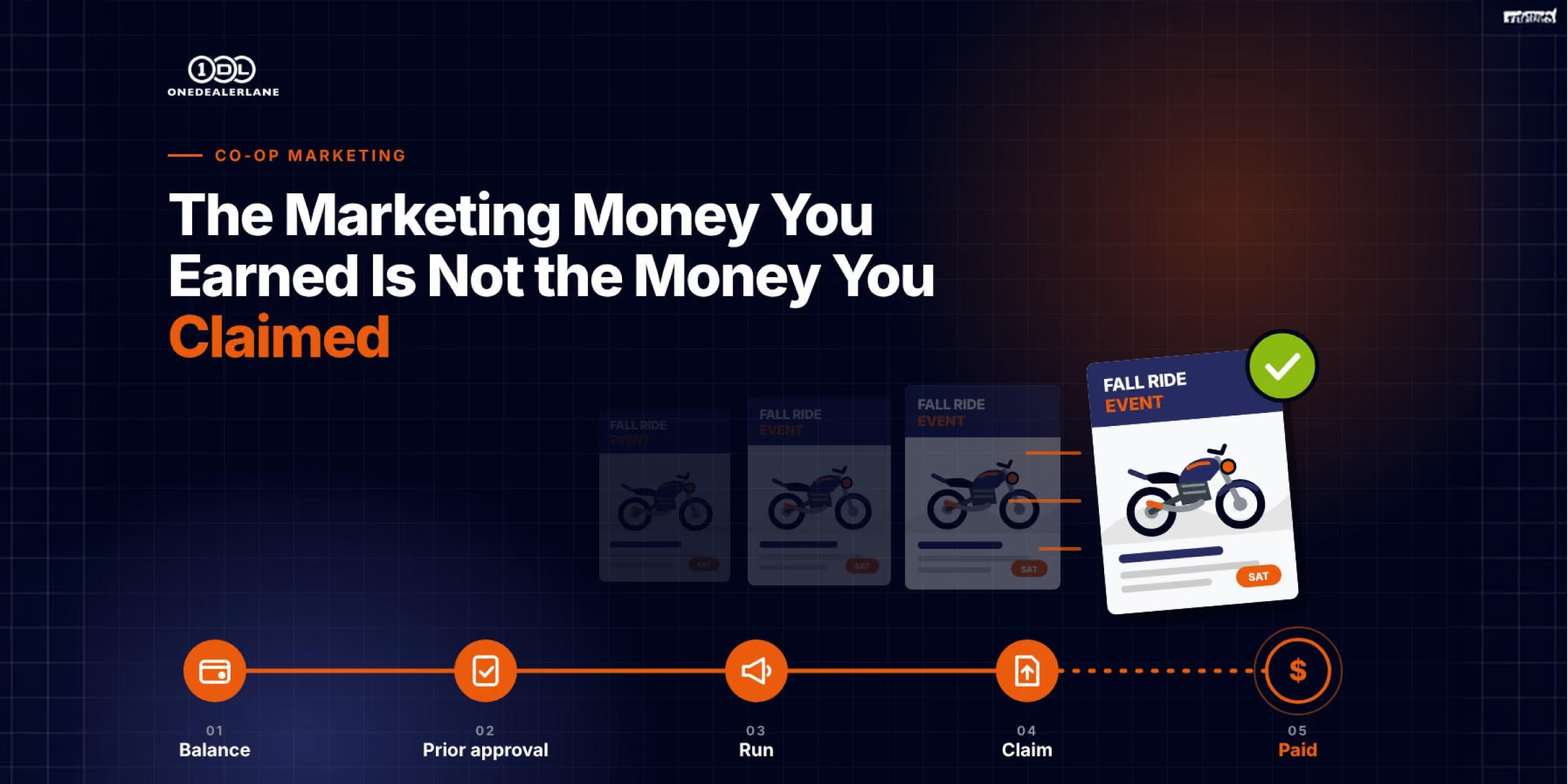
The Marketing Money You Earned Is Not the Money You Claimed
By Zac Jones, Head of Sales & Marketing, One Dealer Lane | Approximately 8-minute read
October 6, 2026
Share:
Key takeaways
Same campaign, different check. Yamaha reimburses co-op at a 40% base rate, or 70% through one of its three approved agencies (Motorcycle & Powersports News, Apr. 2026).
Paperwork decides the payout. One dealer lost more than $13,000 in co-op because it did not have the required event photos (Powersports Business, Aug. 2025).
The clock is real. CFMOTO co-op funds expire May 7 and do not roll over; Harley-Davidson requires dealers to use part of first-half MDF to unlock the second half (MPN, Apr. 2026).
The short answer: a co-op balance is not cash back. It becomes money only when a qualifying claim is approved and paid, and every OEM sets its own rate, media list, pre-approval rule and deadline. Stores that track paid instead of available recover more of what they earned, and they stop funding weak campaigns just because the money is sitting there.
You approve a fall ride event, pay for the banners and run the ads. A month later, someone asks whether it qualified for manufacturer co-op. Nobody checked before the artwork went to print, nobody took the photos the program requires, and the claim window is closing. The event may have worked. The claim probably won't. Most stores watch the first number, the balance in the portal, and never the second one: what actually hit the parts statement.
What co-op is, and why the paperwork is the product
Co-op is money an OEM sets aside to reimburse dealers for advertising its brand, earned on what you sell. The formulas differ: Yamaha bases funds on last year's sales, Polaris works on a six-month cycle tied to current orders, and Harley-Davidson's marketing development fund (MDF) even supports used inventory (Powersports Business).
It is also a regulated category. The FTC's guides under the Robinson-Patman Act list cooperative advertising and online advertising as promotional allowances, expect the manufacturer to run them under a plan offered on proportionally equal terms, and tell the manufacturer to check that the dealer actually performed the advertising it is being paid for (16 CFR Part 240, §§240.7–240.12). That last point is why every program asks for proof. The OEM is supposed to verify, so your invoice, tear sheet and event photos are the product you are really delivering.
Every OEM plays by different rules. Check before the artwork is final
A recent Motorcycle & Powersports News piece urges dealers to confirm balances, eligible media, trademarks and deadlines before spending. The 2026 brand-by-brand review shows why that matters. Rules change every year, and they are not interchangeable:
OEM
2026 detail worth knowing
Yamaha
40% base reimbursement; 70% through one of three approved agencies. Weigh agency fees before assuming the agency route wins.
Kawasaki
Strict trademark and symbol rules on model names; two weeks' notice for event pre-approval; incorrect claims can often be fixed and resubmitted within the claim period.
Honda
2026 guidelines released April 1; more co-op per unit ordered; TikTok added; a Honda-approved agency is still required for paid search.
BRP
First major powersports OEM to reimburse content production, with videography claims up to $250; Google ad claims need local-market targeting.
Harley-Davidson MDF
Two claim categories only (media and events); covers pre-owned advertising; using part of the first half unlocks second-half funds.
CFMOTO
Co-op year runs May 8 to May 7; reimburses at 50%; unused funds do not roll over.
Source: Motorcycle & Powersports News, “A Breakdown of OEM Co-Op Changes in 2026”. Confirm against your current OEM portal. These change annually.
Before planning a campaign, give one person ownership of each manufacturer portal and answer five questions:
- What balance is available right now, and when does it expire?
- Which models and media qualify this year?
- Does this ad or event need prior approval, and how far ahead?
- What logos, trademarks or wording must appear?
- When are the claim and proof due, and what proof counts?
Kawasaki's public co-op guides show why sequence matters. Its prior-approval instructions call for selecting the ad medium and run dates and uploading the files that medium requires; its claim guide asks for run dates, invoice amount and required files. Miss the first step and the second one gets harder.
Plan for the customer, then claim what qualifies
Bring the balance into the same meeting as the marketing budget, but in that order: customer first, co-op second. Pick the customer ride, model landing page, seasonal service push or local show based on what it should produce, then check which portion can be submitted. Never let the existence of funds turn a weak campaign into a good one.
Give every campaign a one-page card before it is approved:
Field
What to write down
Objective
Appointments, visits or qualified conversations you expect
OEM and model
The brand and the qualifying models featured
Spend and expected reimbursement
Projected cost and the rate you expect back
Prior approval
Required? Submitted? Approved on what date?
Required creative
Logos, trademarks and wording the program demands
Run dates and claim deadline
When it runs; when the claim and proof are due
Claim owner
One name, not “marketing”
Result
Net cost after reimbursement vs. what the campaign produced
If several brands appear in one ad, do not assume each OEM pays full freight. Check each brand's rule for shared creative before you allocate the cost.
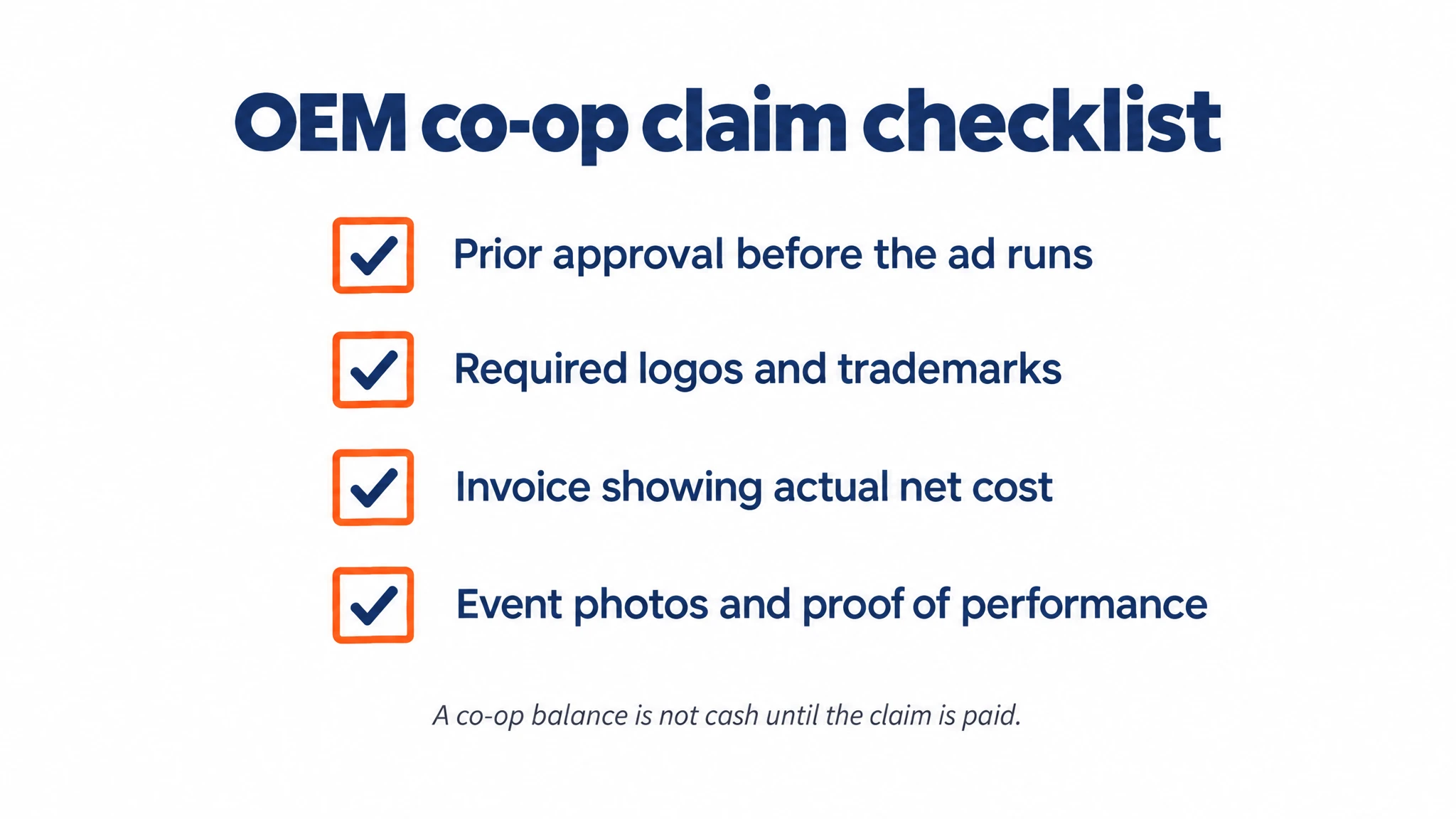
Where claims die: documentation
Co-op programs rarely reject a campaign because it was boring. They reject the claim. Powersports Business lists the usual failures: not knowing the balance, submitting after the deadline, forgetting required trademarks such as Kawasaki's “Ninja” or “Mule,” using a non-approved print vendor and skipping a required pre-approval. The most expensive example it cites is one dealer that lost more than $13,000 because nobody captured the required event photos.
Keep the final ad, the invoice and every piece of proof the program asks for, and make sure the invoice shows what you actually paid. The FTC guides specifically warn against billing a manufacturer above the dealer's actual net advertising cost (§240.13). A clean claim is an honest claim.
A co-op balance is not cash back until a qualifying claim is paid. — One Dealer Lane
Track paid reimbursement, not promises
Review co-op monthly with marketing and accounting, by OEM, using three numbers: available, submitted and paid. The gap between the last two is your rejection rate; the gap between the first two is money about to expire. Set reminders before claim windows close. When a claim is rejected, log the reason and add it to the next campaign's card instead of quietly writing off the balance.
Then judge the campaign on both lines: customer response and dollars recovered. If response was poor, reimbursement does not make it a success. It just made a bad campaign cheaper. The same rule applies everywhere in a dealership: measure what is paid, not what is promised, whether that is a co-op claim, a funded deal or F&I gross per unit.
Frequently asked questions
Does co-op cover events?
Often, if the event is branded and documented. Powersports Business notes signage, branded booths, food and even event photos or video can qualify with proper branding and documentation (source). Kawasaki requires two weeks' notice for event pre-approval (MPN).
Can co-op pay for advertising used units?
Rarely. Harley-Davidson's MDF is described as the only OEM co-op program in powersports that covers pre-owned vehicle advertising (MPN, 2026).
Do unused co-op funds roll over?
Do not count on it. CFMOTO's funds expire May 7 with no rollover, and Harley-Davidson ties second-half MDF to first-half use (MPN, 2026). Check each program's calendar.
Is an OEM-approved agency always worth it?
Not automatically. Yamaha pays 70% through an approved agency versus 40% base, but the agency's fee comes out of that difference (MPN, 2026).
The bottom line
Co-op money is not a growth strategy on its own. It is a funding discipline for campaigns you would be proud to run without reimbursement. Know the rules before you spend, submit the proof on time, and judge every campaign on customer response and dollars actually recovered.
About the author
Zac Jones is Head of Sales & Marketing at One Dealer Lane. He works with powersports, marine and RV dealers on practical sales, marketing and customer-experience improvements.
Sources
- Motorcycle & Powersports News – Money Set Aside for Marketing (Sept. 24, 2026)
- Motorcycle & Powersports News – A Breakdown of OEM Co-Op Changes in 2026, Jacob Berry (Apr. 30, 2026)
- Powersports Business – Making the most of your OEM co-op program (Aug. 28, 2025)
- Kawasaki Co-op Resource Center – Request Prior Approval
- Kawasaki Co-op Resource Center – Submit Claim
- Federal Trade Commission – Guides for Advertising Allowances and Other Merchandising Payments and Services, 16 CFR Part 240
Back to Top
Get more from every deal
Sign up for a free trial and start driving higher gross this month. No commitment, just results.
(877) 421-0135