Back
The Trade-In Is Where Powersports Gross Goes to Die
By Robert Ward, Sales Advisor & Trainer, One Dealer Lane | Approximately 7-minute read
September 17, 2026
Share:

Direct Answer
The trade-in is where powersports gross quietly disappears because most desks price it from memory, a guide nobody's reopened in weeks, or a single blanket "the market is soft" read — while actual values move by segment and by month. Treat the trade number like any other live desking input: give it a pull date, not a permanent memory.
The Number Nobody Re-Checks
Sale price gets negotiated line by line. F&I gets a menu and a documented process. The trade-in, more often than it should, gets a number someone remembers from three deals ago, or a figure pulled from a guide that's been sitting open on the same browser tab since last month.
That one number does two jobs at once. It sets the customer's payment expectation, and it sets how much front-end gross the store actually keeps. Miss it high, and the store eats the difference at auction or lets the unit age on the lot. Miss it low, and the customer walks — or the salesperson quietly "makes it work" by giving gross back somewhere else in the deal to save face.
Neither failure shows up on the deal recap as "the trade was wrong." It shows up as "gross was soft this month" or "we lost that one to financing," and almost nobody traces it back to a number that was already stale before the customer sat down at the desk.
One Blanket Trade Number Is a Guess, Not a Policy
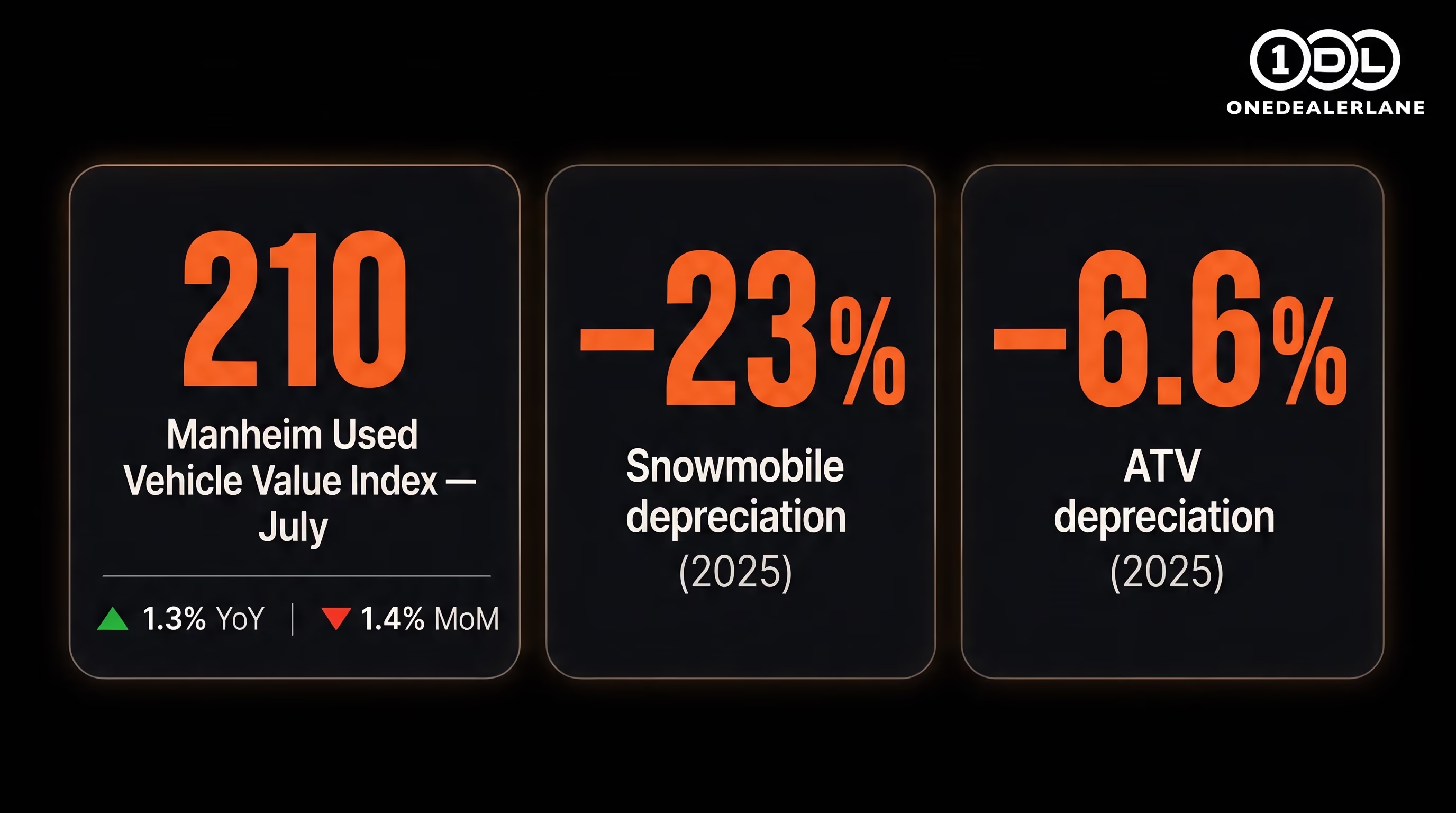
Black Book's Q2 2026 Motorcycle & Powersports Market Update — published May 4, 2026, covering performance entering the first quarter of the year — breaks out exactly how differently powersports segments are moving in the same window:
That's a roughly 15-point swing between the best- and worst-performing segments in the exact same quarter. A desk that prices every trade off a single mental read — "market's up" or "market's soft" — is applying a Scooter trend to a Watercraft trade, or an ATV swing to a Cruiser. Add in Black Book's motorcycle retention data, which spans nearly 35 points by model year alone (50.8% of original MSRP for 2019 models versus 85.3% for 2026 models), and "give it 60% and move on" isn't a policy. It's a coin flip with the store's gross on the other side.
Even the Direction Can Flip Inside a Month
It isn't just that segments move differently from each other — the overall market can shift meaningfully within a single desking cycle. Cox Automotive's Manheim Used Vehicle Value Index closed July 2026 at 210, up 1.3% year-over-year but down 1.4% from June, and roughly 2.5% below the March high for the year.
"Wholesale values kept normalizing through July, continuing the pattern since the spring bounce peaked in March," said Jonathan Gregory, Senior Director at Cox Automotive, in the company's Aug. 7, 2026 report. "The Manheim Index closed the month at 210, down 1.4% from June and about 2.5% below that March high."
The point isn't to forecast next month's index at the desk — nobody's asking a salesperson to do that. The point is that "the number I quoted three weeks ago" is a specific, checkable claim with a specific, checkable shelf life. It doesn't stay true just because nobody's challenged it yet.
Dealers Are Already Building Toward This
This isn't a hypothetical fix. A handful of tools built specifically for powersports trade valuation and inventory pricing are already attacking the same guesswork problem from different angles — proof the industry already knows the blanket-number habit needs to end.
MotoMate123, a trade-appraisal and used-inventory tool built for powersports dealers, has processed more than 4 million trade appraisals since 2017. In 2024, the company integrated Black Book's own segment-level pricing data — the same data behind the by-segment breakdown above — directly into its appraisal engine.
“MotoMate123’s partnership with Black Book exemplifies our commitment to providing our clients with the best possible product,” said Tom O’Connor, President and Co-Founder of MotoMate123, when the integration launched. “Our tool is considered a game changer because it helps managers make smarter decisions with the dealer’s investment dollars.”
Apex2Ride, an AI-driven appraisal and inventory platform built for powersports dealerships, makes the same case from the opposite direction: replacing the memory-based estimate with a real-time one. “Since implementing Apex2Ride, our pricing strategy is data-driven and competitive, leading to faster sales and higher margins,” said Lisa T., a Sales Manager, in a testimonial published on the company’s site.
MotoHunt, a powersports inventory marketplace, rolled out a fresh round of upgrades on Aug. 11, 2026, aimed at the same problem from the inventory side: dealer-configurable aging bands, a live pricing-and-inventory-history view, and automated “Hot,” “Popular,” and “Cold” badges that flag which units are actually moving and which are quietly aging on the lot.
None of these tools do the same job Sales Lane does — they solve appraisal and inventory pricing, not the desk itself. But they're all pointing at the same conclusion this article is making: a trade or inventory number is only useful for as long as it's current, and the operators pulling ahead right now have stopped treating “current” as optional.
Where the Desk Actually Breaks
The failure rarely looks like one bad decision. It's usually three small ones, stacked:
- The eyeball estimate becomes the anchor. A salesperson ballparks the trade from memory during the test ride to keep the customer engaged — and that ballpark becomes the number the customer mentally locks onto, whether or not it survives a real appraisal.
- The real number lives somewhere else. The actual appraisal happens in a notebook, a text thread, or a separate valuation tool the desk manager checks after the fact — not inside the same worksheet as sale price, rate, and F&I, which get revised live in front of the customer while the trade number quietly doesn't.
- Packages get blended instead of itemized. A UTV-and-trailer trade, or two ATVs from the same household, get valued as one blended guess instead of priced component by component — which hides exactly which piece is dragging the number down.
A Trade-Appraisal-to-Desk Workflow That Actually Holds
None of this requires a new appraisal method — it requires putting a date on the number and keeping it inside the deal instead of beside it:
The discipline is small on paper and expensive to skip in practice. A rate sheet gets audited. A menu gets a documented process. The trade — the one number most likely to move by double digits between segments in the same quarter — usually gets neither.
Where This Fits Inside the Desk
Inside Sales Lane, the trade value lives in the same desking worksheet as sale price, rate, and F&I — not a separate note passed between the lot and the desk manager — so the number the customer hears is the number the deal is actually built on, with a visible pull date instead of an undated guess.
Sales Lane isn't trying to replace tools like MotoMate123, Apex2Ride, or MotoHunt — dealers who already use one of them for appraisal or inventory pricing should keep doing so. The job inside the desk is simpler and narrower: whatever number one of those tools produces, or whatever a manager pulls by hand, needs to land on the worksheet with a date attached and stay current until the deal is signed — not get copied once and forgotten.
The sale price gets negotiated. The F&I menu gets a process. The trade-in deserves the same discipline — a number with a date on it, sitting inside the same desk the rest of the deal runs on. — One Dealer Lane
About the Author
Robert Ward is a Sales Advisor & Trainer at One Dealer Lane, where he works with powersports sales teams on desking discipline, trade-in accuracy, and the habits that protect front-end gross. He writes about the sales-floor realities that separate a documented process from a guess.
Sources
- Cox Automotive — "Manheim Used Vehicle Value Index: July 2026 Trends" (Aug. 7, 2026)
- Black Book — "Q2 2026 Motorcycle & Powersports Market Update" (published May 4, 2026)
- Cox Automotive — Q2 2026 Dealer Sentiment Index
- Black Book — "Black Book Integrates Comprehensive Data into MotoMate123 to Revolutionize Powersports Industry Appraisals" (March 26, 2024)
- Apex2Ride — company website (customer testimonial)
- Powersports Business — "MotoHunt adds new upgrades to help dealers better manage inventory" (Aug. 11, 2026)
- Internal signal — dealer interest in trade-tool / instant-offer integrations, referenced by theme (2026)
Back to Top
Get more from every deal
Sign up for a free trial and start driving higher gross this month. No commitment, just results.
(877) 421-0135