Back
Why Your F&I Menu Just Skipped a Product It Should Have Sold
By Erik Smith, Sr. Product Operations Analyst, One Dealer Lane | Approximately 5 minute read
August 3, 2026
Share:
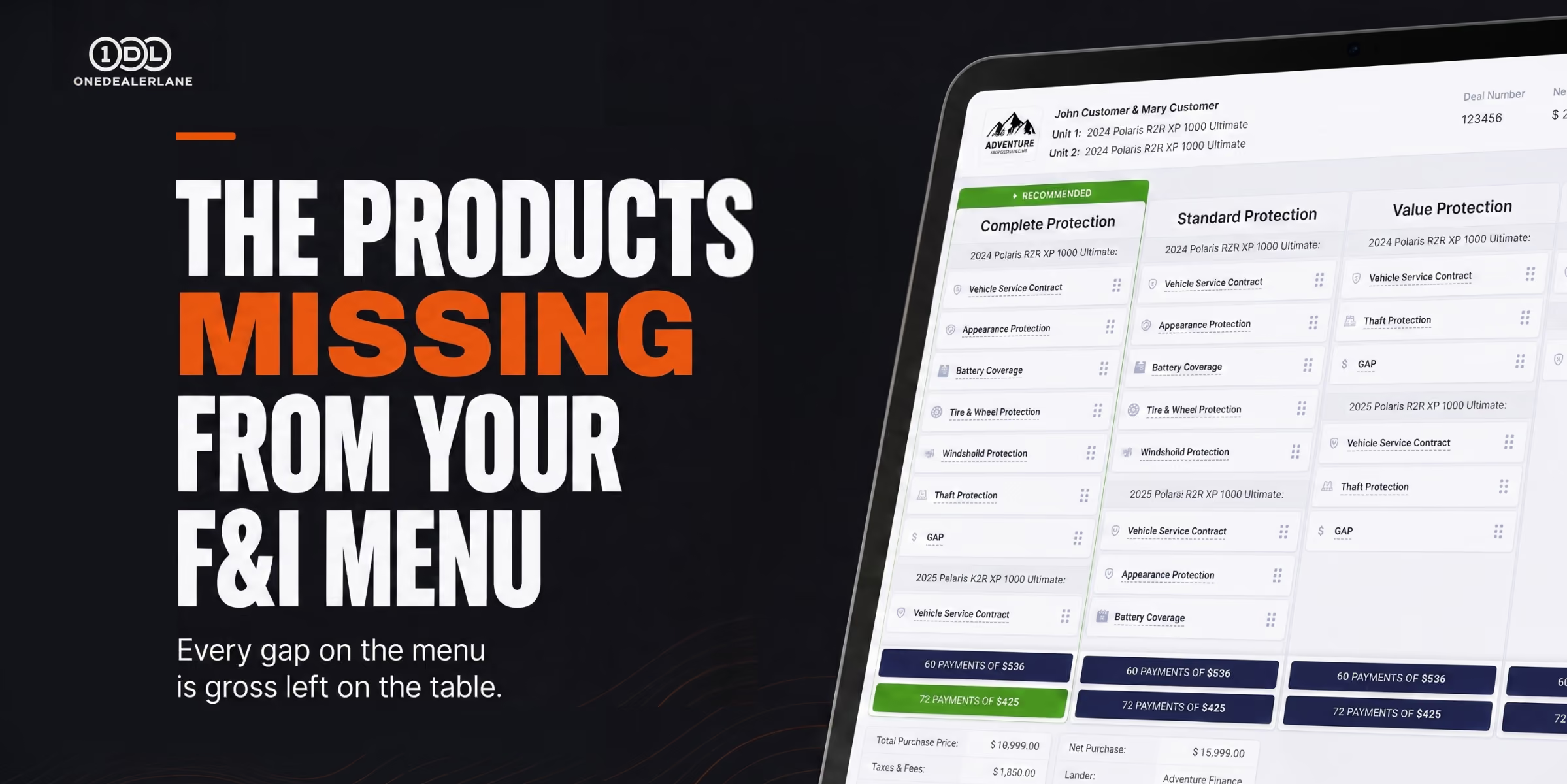
When an expected product disappears from the menu, the dealership needs a disciplined way to diagnose the cause, escalate it, keep valid choices available and prevent the same lost presentation from happening again.
The customer wants prepaid maintenance. The F&I manager opens the menu, enters the unit and the product never appears. A savvy manager knows the product should be there and raises the issue. Others assume it is unavailable, skip the presentation and move on. The customer loses a choice, and the dealership loses potential F&I revenue.
This happens because a digital menu does not invent a product rate. It depends on several systems agreeing about the unit, the customer's use, the dealership's enrollment and the product's eligibility. New trims, limited editions, electric variants, personal watercraft, snowmobiles, trailers and serial-number units can reach the showroom before every catalog and integration recognizes them.
First diagnose why the product disappeared
The first question is not, "What unit should I choose instead?" It is, "Why did the expected product disappear?" A missing result can mean the unit did not decode, the exact year/make/model is absent, the product is not mapped to the dealer, the customer or usage type changed eligibility, a required field is missing, or the rating connection failed. Each cause has a different fix.
Before skipping the product, verify the basics. Confirm the VIN, HIN or serial number; year, make, model and engine size; new versus used status; personal versus commercial use; customer type; in-service date; and dealership product setup. Check whether other products rate on the same unit. If the provider offers its own portal, see whether the product appears there. That comparison helps separate a unit-data problem from a menu integration or dealer-configuration problem.
Some product providers support an alternate year/make/model, engine-size or category rating path when VIN or HIN decoding fails. Many do not. Use that path only when the provider has explicitly defined it. If no supported fallback exists, the product may need to be quoted through the provider's own approved process—or held until eligibility can be confirmed. The cost of an invalid contract is greater than the gross on one rushed sale.
Escalate a case that can actually be solved
A good escalation gives the menu company and product administrator enough evidence to diagnose the issue without another round of questions. Include the date and time, store, deal reference, unit year/make/model, masked VIN or HIN, new/used and usage type, expected product, exact error or missing-result behavior, screenshot, steps already tried and whether the provider portal produced a rate. Do not include unnecessary customer personal information.
Then ask for more than a workaround. Request the root-cause category, the owner of the correction, the expected resolution and whether any other units or deals are affected. Was the model absent from a catalog? Was the dealer's product enrollment incomplete? Was the product mapped incorrectly? Did the integration fail? The answer determines whether the fix belongs with the dealership, menu provider, data aggregator or product administrator.
Recording the incident only matters if someone closes the loop. Track it until the catalog, mapping or configuration is corrected. Notify the F&I team when the product is available again. Review any open or recently delivered deals that may have missed the same presentation, and follow up only when appropriate and permitted. A resolved ticket should improve the primary workflow, not become a permanent manual habit.

Keep the deal moving only through an approved path
The best continuity path is one the dealership approved before a customer was waiting. There are three legitimate possibilities: a provider-supported alternate rating path; the provider's direct portal with its approved rate and contract; or a preconfigured dealership product built from a current authorized rate card with the correct agreement attached. If none exists, present the other eligible products, explain that one option is being verified and do not manufacture a rate.
Every continuity path should preserve the same controls: unit eligibility, rate source and version, dealer cost, retail price, required disclosures, correct contract form and user. The menu should record what was presented, selected or unavailable. The exception record should show why the normal rating path failed and which approved process was used.
Close the loop and measure the lost opportunity
Do not manage this as isolated anecdotes. Track rating exceptions by product, unit type, model year and cause. Measure how many expected products disappeared, how many deals used an approved continuity path, how much presentation opportunity was recovered and how long root-cause resolution took. Repeated failures reveal catalog, setup or integration weaknesses that deserve a permanent fix.
When evaluating a menu or F&I platform, ask what happens when a product does not return. Can the system distinguish no eligibility from a technical failure? Can the manager see which input caused the problem? Does it support approved alternate products and contracts? Does it preserve presentation and exception history? Can it route a complete case to the right partner and report recurring failures?
What to expect from a resilient F&I workflow
This is where a connected workflow matters. One Dealer Lane is designed to keep the unit, customer context, product presentation, contract and exception history on the same deal record while connecting the dealership's existing systems and F&I partners. The goal is not to force every product onto every unit. It is to keep every eligible product visible, make missing products diagnosable and prevent a temporary data problem from becoming permanent lost revenue.
When a product disappears from the menu, the real loss is not an error message. It is a customer choice that may never be presented. — One Dealer Lane
Keep every eligible product visible, every exception diagnosable and every approved rate and contract attached to the same connected deal record
One Dealer Lane brings desking, credit, F&I menus, and eSignature into a connected workflow. Request a 20-minute walkthrough. Free, no commitment.
About the author
Erik Smith is Sr. Product Operations Analyst at One Dealer Lane, a platform built by powersports dealers for powersports dealers. He works with powersports, marine, and RV dealers and industry partners on connected desking, product-rating, contracting, and F&I workflows that fit the units dealers actually sell. He writes about dealership technology and the operational gaps that surface when real-world recreation deals meet systems built around cleaner automotive data.
Sources
- StoneEagle Q4 2025 F&I performance (auto ~$1,995/unit, 1.58 products/deal), reported in AutoSuccess, Feb 23, 2026 — https://www.autosuccessonline.com/sales-side-pressure-deepens-as-fi-posts-q4-record/
- VisionAST / Lightspeed 2025 powersports benchmarks (~$700/unit; 0.57–0.74 products/deal; finance penetration record 53%), via Motorcycle & Powersports News — https://www.motorcyclepowersportsnews.com/how-powersports-dealers-are-thriving-amid-industry-uncertainty/
- Powersports Business, “Why 20 Groups remain a dealer’s best competitive advantage” (NCM: top dealers ~9.8% net vs 5.4% avg), Jul 30, 2026 — https://powersportsbusiness.com/features/2026/07/30/why-20-groups-remain-a-dealers-best-competitive-advantage/
- Cox Automotive Q2 2026 Dealer Sentiment Index (profit index 36; cost index 74, highest in >1 yr) — https://www.coxautoinc.com/insights/q2-2026-cadsi/
- PCMI, “Anchoring Profits: Why the F&I Office Matters Today” (nearly half of buyers take just 1–2 F&I products), Mar 2026 — https://www.pcmicorp.com/2026/03/anchoring-profits-why-the-f-and-i-office-matters-today/
- Internal research - anonymized powersports dealer, menu-platform and product-administrator rating exception workflows (2025-2026)
- One Dealer Lane - The hidden reason your F&I is losing time (and profit)
- One Dealer Lane - The F&I KPIs Most Powersports Dealers Don't Track (But Should)
- One Dealer Lane - 5 Best Software Platforms for Powersports Dealers in 2026
Back to Top
Get more from every deal
Sign up for a free trial and start driving higher gross this month. No commitment, just results.
(877) 421-0135