Back
All-In or All-Risk: What the FTC’s Pricing Enforcement Means for Your Powersports Dealership
By Param Ramakrishnan, CEO, One Dealer Lane • ~9 minute read
June 17, 2026
Share:

In January, dealers across the country exhaled. The FTC’s CARS Rule was dead. Here’s what nobody told the powersports floor: the rule was never the thing that could fine you. The law behind it — the one that just pulled $75 million out of a single dealer group — never went anywhere. And it doesn’t care whether you sell trucks or dirt bikes.
Before you read another word — four quick questions:
- Does your dealership website list freight and dealer prep in the advertised price on every inventory listing — or does a tooltip say “+ freight + prep”?
- When did you last search your own Facebook page for “as low as $X/month” ads — and do those ads disclose the rate, term, and down payment?
- Has a customer ever walked in with a screenshot of your website price and expected you to honor it exactly? What did you say?
- And honestly — did you know that powersports dealers are subject to the same FTC pricing standards that just put 97 auto dealership groups on notice in 2026?
If any of those questions made you pause, keep reading. If none of them did — especially that last one — keep reading even faster.
The rule is dead. And that’s the problem.
In January 2025, the 5th Circuit Court of Appeals vacated the FTC’s CARS Rule — the sweeping dealer-advertising regulation the FTC had spent years building. The National Automobile Dealers Association challenged it on procedural grounds, the court agreed, and on Feb. 12, 2026, the FTC formally withdrew the rule from the Federal Register. The CARS Rule is dead.
Here’s the part many dealers missed: the CARS Rule was never the authority. It was just one way to apply authority that has existed since 1914. Section 5 of the FTC Act — which prohibits “unfair or deceptive acts or practices” — is still fully in force, was not part of the vacated rule, and is the basis the FTC has used to fine, sue, and settle with dealerships for decades. The rule changed. The enforcement power didn’t.
Plenty of dealers heard “CARS Rule died” and exhaled. That exhale was premature.
Are powersports dealers paying attention? Honestly?
Probably not. And it’s not hard to understand why.
When the FTC sent warning letters to 97 auto dealership groups on March 13, 2026, every name on the list was an auto megagroup: Lithia Motors, AutoNation, Group 1 Automotive, Sonic Automotive, Berkshire Hathaway Automotive, Hendrick Automotive Group. Not one powersports dealer. Not one marine or RV store. 203 locations across the 97 named groups, all franchised car dealers.
Easy to read that as “not my problem.” Small store. Independent. Not on anyone’s radar. FTC is busy with billion-dollar dealer groups.
But the NPDA’s May 12, 2026 compliance webinar — featuring attorney Leonard Bellavia, who specifically represents powersports dealers — drew more than 230 attendees and generated more than 50 questions. Not legal curiosity. Real concern, real confusion.
Some of the questions from the Q&A published by NPDA afterward tell you everything:
- “Does this apply to me if I only advertise online?” Answer: Yes.
- “Can I list an ‘internet price’ different from my in-store price?” Answer: No. There’s no legal distinction.
- “What if the ad says ‘estimated’?” Answer: “Estimated pricing is prohibited.”
Then there’s the Reddit thread — posted in r/motorcycles, hundreds of upvotes — from a rider who paid $9,800 out-the-door on a bike advertised at $6,400 MSRP. More than $3,400 in added freight, prep, fees, taxes, and tags. The comments section is a master class in consumer outrage. Those are your potential complainants.
We’ve always done it this way is not going to be a strong defense. — Mark Sheffield, industry consultant, LinkedIn, May 2026
What the FTC actually put on paper in March 2026
The March 13 warning letters weren’t ambiguous. The FTC spelled out six specific advertising practices it considers deceptive or unfair — and attached a maximum civil penalty of $53,088 per violation.
Per violation. Not per incident, not per campaign, not per dealership. Per. Violation.
Bellavia confirmed after the webinar: these practices apply to powersports dealers with no carve-outs, no size exemption, and no “internet only” exception. State AGs run parallel enforcement under their own consumer protection laws (Texas DTPA, California CLRA, and others). You don’t need to be in the FTC’s sights first.
The six things the FTC says you can’t do
- Advertise a price that excludes mandatory fees. Freight, dealer preparation, and documentation fees are mandatory — the customer cannot avoid them. If your listing says $18,999 and the actual price before taxes/tags is $19,949, your advertisement is misleading.
- “As low as $X/month” without full loan terms. Every payment ad must disclose the APR, loan term, and down payment. “As low as $299/month” is not a price; it’s an invitation to a complaint.
- Bait-and-switch advertising. Advertising a price on a unit that’s sold, pending, or unavailable is a violation. Sold units should come off your website immediately — not stay live because they’re good for SEO.
- Payment packing. Rolling optional F&I products into a quoted monthly payment without the customer’s knowledge and explicit consent. The FTC defined this specifically in its Asbury/David McDavid case, naming three Texas dealerships.
- Not honoring the advertised price. If a customer arrives with your advertised price, “discounts apply only to stock on hand” in the fine print doesn’t protect you. The headline price is what they relied on.
- Fine-print corrections that don’t fix a misleading headline. Per Solera/Spireon’s legal advisory: “Disclosures appearing in fine print or later in the transaction process generally will not be sufficient to correct a misleading headline price.” The asterisk doesn’t save you.
One more: Bellavia noted that personal liability extends to managers, not just the dealership entity. Your F&I manager, your sales manager, your GM — exposure isn’t limited to the name on the building.
The OEM pricing trap — a problem dealers didn’t create
The NPDA called it out directly in their April 23, 2026 white paper: OEMs still publish MSRPs that exclude freight and dealer setup. The number on BRP’s, Polaris’s, or Yamaha’s website does not include the charges that every customer must pay at delivery.
Michael Maledon, writing for NPDA, put it plainly:
Dealers did not create this problem, but they are the ones being held accountable. — Michael Maledon, NPDA
The NPDA white paper asked OEMs to integrate freight and setup reimbursement into the published MSRP so that dealers can advertise the real price. That conversation is ongoing. Until it resolves, the dealer carries the compliance risk.
And it’s not just your website. GarageCast’s Matt Groves (Ep. #343, May 12, 2026) made a point that should hit close to home: audit your individual salespeople’s social media accounts. A salesperson running their own Instagram reel with the sticker price and a payment estimate — even unintentionally — creates dealership liability.
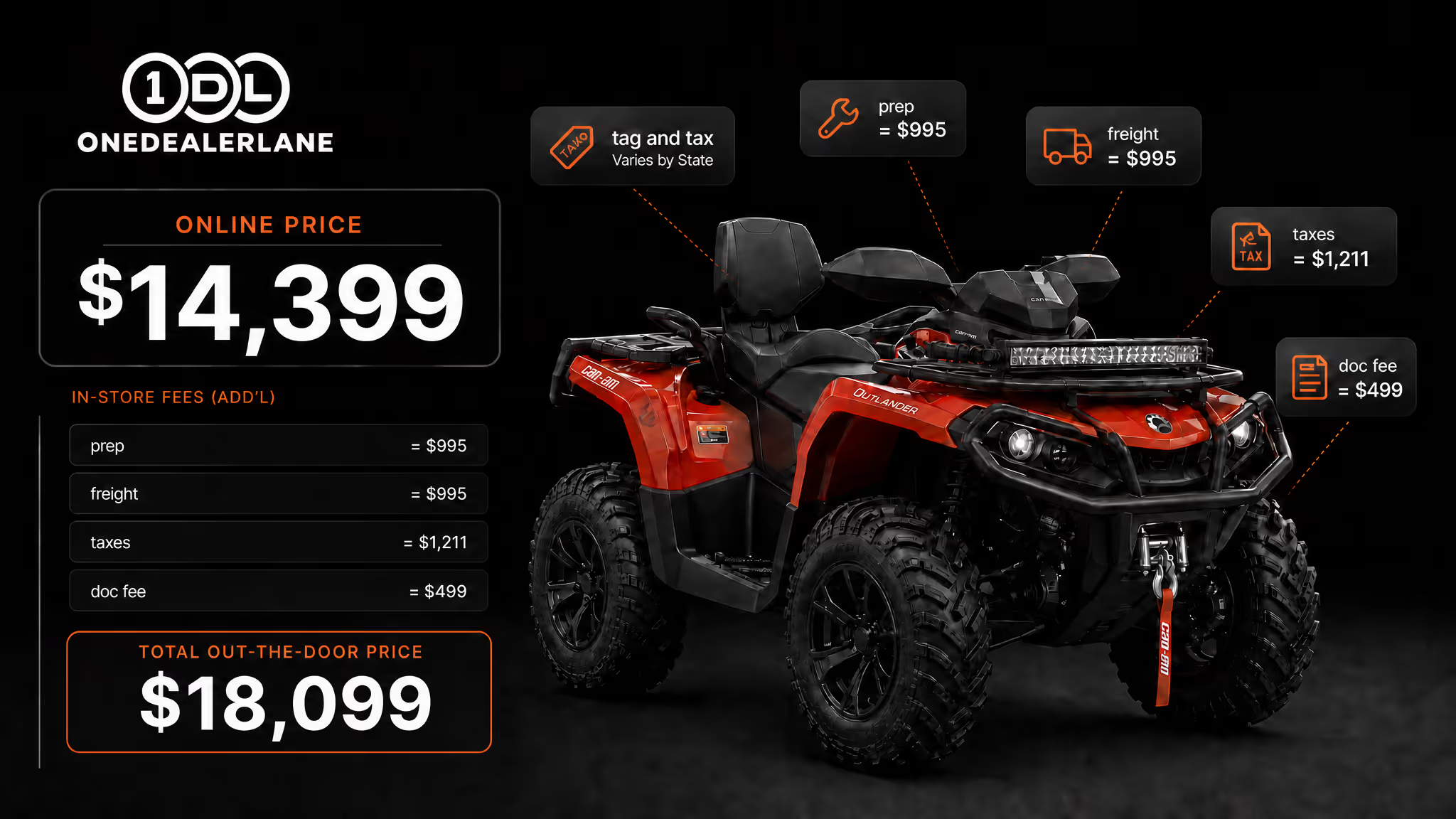
What losing looks like
Lindsay Automotive Group operates in Maryland and Virginia. On April 2, 2026, the FTC and Maryland’s Attorney General jointly announced a settlement: a $75 million customer redress pool plus a $3.1 million state penalty. The FTC’s investigation found that 88% of customers paid $2,000 or more above the advertised price. Not 5% above. Not a rounding error. $2,000 or more — per customer — on deals that advertised one number and delivered another.
The Asbury Automotive Group case — which named three Texas David McDavid dealerships — specifically addressed payment packing: optional F&I products buried in the monthly payment without customer knowledge. The FTC treated each instance as a separate violation.
Both cases are large auto groups. There is no documented FTC enforcement action against a powersports dealer as of June 2026. The FTC has a long docket and finite resources. But Section 5 has no size threshold. State AGs have independent enforcement authority. And as of April 17, 2026, the FTC has publicly invited your competitors to flag you.
The wildcard: your competitors can now report you
Five things to do before next Monday
This isn’t legal advice — have your attorney review your specific practices. But here’s where most powersports dealers should start:
- Audit every inventory listing on your website. Freight and dealerprep must appear in the advertised price — not in a tooltip, not in anasterisk, not on the "contact us" page.
- Search your dealership’s social accounts (and your salespeople’s). Look for "as lowas" payment ads. Remove them or add complete loan-term disclosures: rate,term, and required down payment.
- Take sold and pending inventory off your website now. Advertising a price ona unit you can’t sell is a textbook violation, and it’s one of the easiest fora competitor or regulator to spot.
- Brief your F&I desk on payment packing — and audit your menuprocess. Optional products must be presented, priced, and accepted separatelyfrom the base payment. A compliant F&I menu tool should show the customerboth the base payment without products and the final payment witheach selected product on the same screen — no ambiguity about what is, andisn’t, included. The customer should also sign (digitally or on paper)acknowledging acceptance of each product they chose. Many powersports dealersskip the menu entirely and present a Four Square with a single bundled payment— no itemization, no customer signature on the add-ons. That’s exactly thepayment packing the FTC targets. If you’re not using a menu that generates thisdisclosure and captures that acceptance, fixing your website listings is onlyhalf the job.
- Have your attorney run your advertising against the six prohibitedpractices. Do it before the FTC does, before a state AG does, or before the dealertwo miles away does it for them.
The powersports industry hasoperated outside the FTC’s direct crosshairs so far. That’s not a guarantee —it’s a lag. The rules that apply to the auto dealers who just got warningletters apply to your store too. The enforcement timeline just hasn’t caught upyet.
All-in pricing isn’t just a compliance checkbox. It’s a customer trust signal. The dealer who shows freight and prep upfront doesn’t lose the sale — they close faster, with fewer objections, because the customer didn’t feel ambushed. The risk calculus has shifted. Getting ahead of it costs an afternoon. Getting caught costs up to $53,088 per violation.
Legal disclaimer
This article is for general informational purposes only and does not constitute legal advice. Advertising and pricing compliance rules vary by state and situation. Consult a qualified attorney before making changes to your dealership’s advertising practices.
Sources and further reading
- NADA v. FTC, 5th Cir. No. 24-60013 (Jan. 27, 2025) — https://www.ca5.uscourts.gov/opinions/pub/24/24-60013-CV0.pdf
- Holland & Knight — “Fifth Circuit Strikes Down FTC’s Auto Retail Scam Rule” (Feb. 4, 2025) — https://www.hklaw.com/en/insights/publications/2025/02/fifth-circuit-strikes-down-ftcs-auto-retail-scam-rule
- Federal Register — Withdrawal of CARS Rule (Feb. 12, 2026) — https://www.federalregister.gov/documents/2026/02/12/2026-02866/revision-of-the-negative-option-rule-withdrawal-of-the-cars-rule-removal-of-the-non-compete-rule-to
- FTC Press Release — 97 Warning Letters to Auto Dealership Groups (March 13, 2026) — https://www.ftc.gov/news-events/news/press-releases/2026/03/ftc-warns-97-auto-dealership-groups-about-deceptive-pricing
- Carscoops — “FTC Named All 97 Dealers” (June 2, 2026) — https://www.carscoops.com/2026/06/ftc-dealer-pricing-warning/
- NPDA White Paper — Pricing & Advertising Compliance (April 23, 2026) — https://www.npda.org/media/pricing-white-paper
- Powersports Business — “NPDA White Paper Urges OEM Pricing Overhaul to Meet FTC Rules” (April 29, 2026) — https://powersportsbusiness.com/news/dealers/2026/04/29/npda-white-paper-urges-oem-pricing-overhaul-to-meet-ftc-rules-protect-dealers/
- NPDA — Bellavia Q&A: FTC Pricing & Advertising Compliance Questions for Powersports Dealers (May 17, 2026) — https://www.npda.org/post/ftc-pricing-advertising-compliance-questions-for-powersports-dealers
- DealerLaw.com — Bellavia Webinar Recap (May 2026) — https://www.dealerlaw.com/2026/05/powersports-dealerships-and-the-impact-of-recent-ftc-notices-of-deceptive-pricing/
- GarageCast Ep. #343 — Matt Groves, FTC Compliance (May 12, 2026) — https://www.buzzsprout.com/205564/episodes
- FTC — Lindsay Auto Group Settlement, $75M Redress + $3.1M MD Penalty (April 2, 2026) — https://www.ftc.gov/news-events/news/press-releases/2026/04/ftc-maryland-attorney-general-secure-full-refunds-additional-penalties-against-lindsay-auto-group
- FTC — Asbury Automotive / David McDavid Payment Packing Case — https://www.ftc.gov/car
- CBT News — “FTC Warning Letters and Social Media Risk” (June 1, 2026) — https://www.cbtnews.com/ftcs-warning-letters-social-media-teams/
- CBT News — “FTC Invites Dealer-on-Dealer Reporting” (April 21, 2026) — https://www.cbtnews.com/ftc-to-report-competitors-for-deceptive-pricing/
- Carscoops — “Autotrader/Cars.com Changing Displays” (June 4, 2026) — https://www.carscoops.com/2026/06/ftc-dealer-pricing-listing-sites/
- Solera/Spireon — FTC Warning Letter Advisory (May 11, 2026) — https://www.solera.com/blog/2026/05/11/ftc-warning-letter-to-automotive-dealers-dated-march-13-2026/
Back to Top
Get more from every deal
Sign up for a free trial and start driving higher gross this month. No commitment, just results.
(877) 421-0135