Back
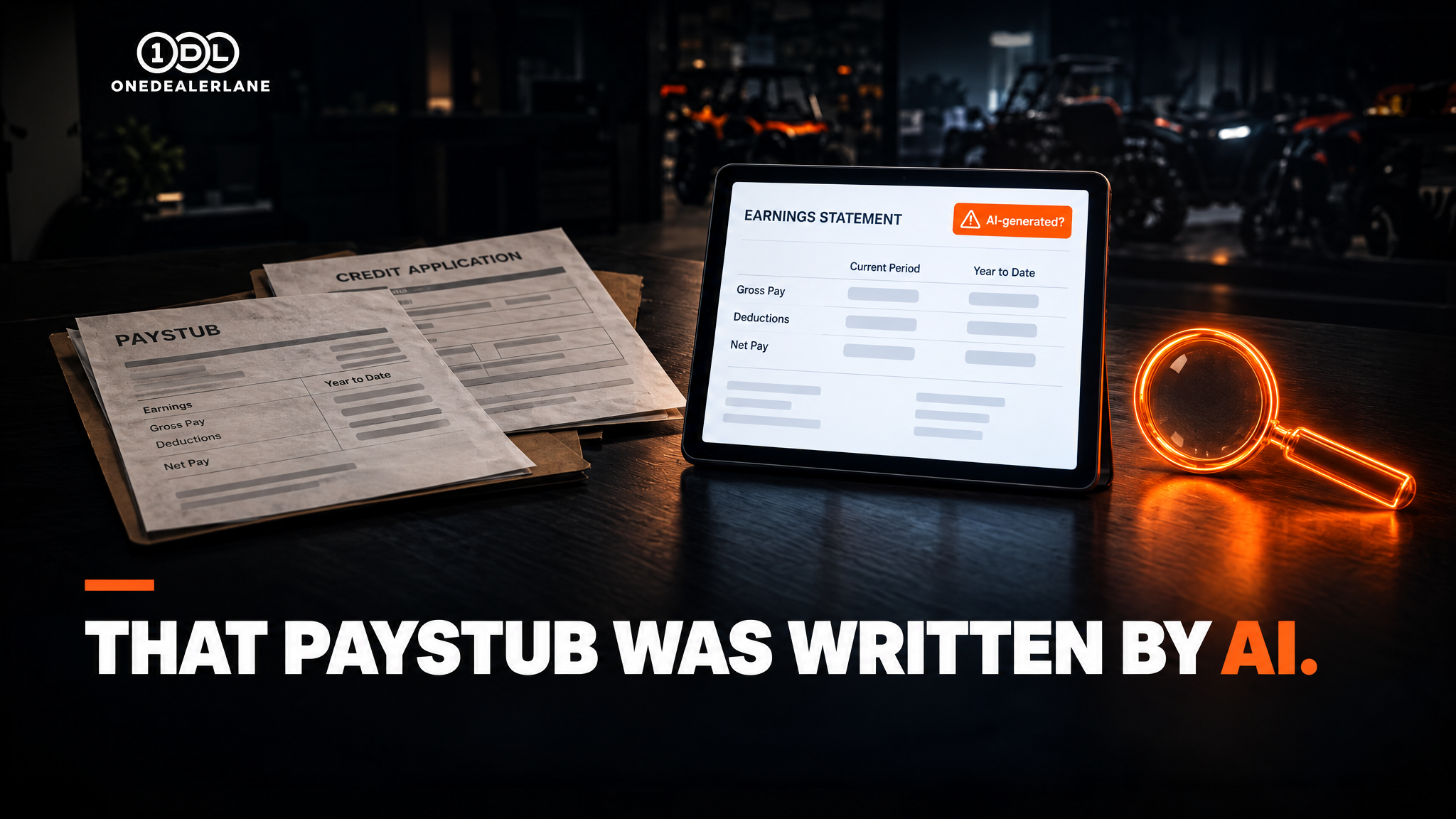
AI Is Writing Fake Paystubs. Is Your Credit App Ready?
By Zac Jones, Head of Sales & Marketing, One Dealer Lane | Approximately 6-minute read
October 23, 2026
Share:
Key takeaways
Point Predictive's 2026 Auto Lending Fraud Trends Report puts auto lending fraud exposure at a record $10.4 billion, up from $9.2 billion the year before (auto-industry data).
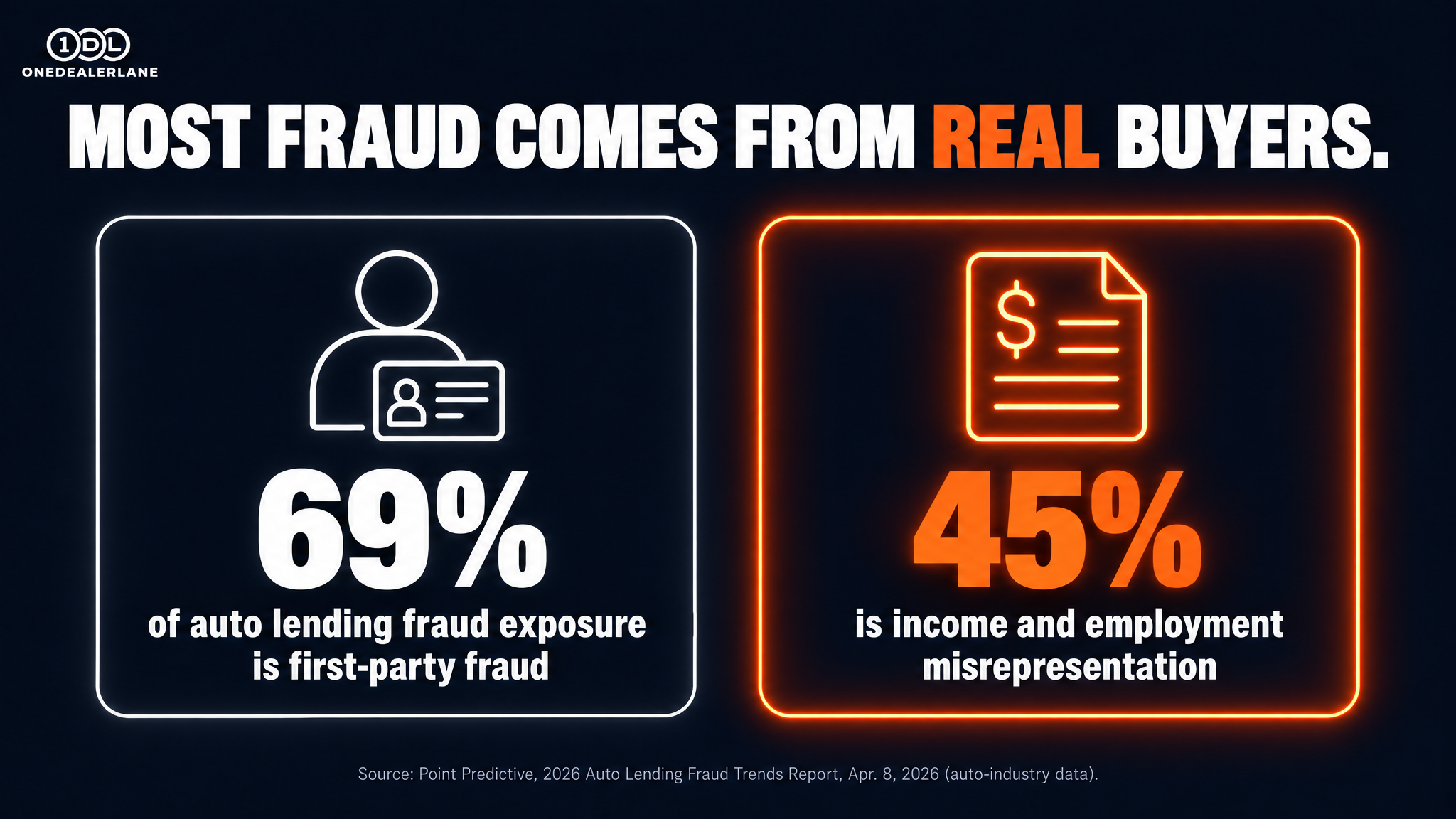
First-party fraud, where a real buyer misstates their own information, accounts for 69% of that exposure, according to Point Predictive.
Income and employment misrepresentation makes up 45% of fraud exposure and grew 21% year over year, per Point Predictive's April 2026 release.
The FTC's Red Flags Rule requires covered creditors to run a written program that identifies, detects and responds to identity theft warning signs.
The Direct Answer
Dealers catch dealership credit application fraud by checking every app the same way before it reaches the lender. Verify identity against the ID in hand, capture data once from the source document, test income and employment against an independent source, and stop the deal for a named sign-off when anything doesn't match. Today's fraud looks like a normal customer with a clean paystub, so gut feel won't catch it. A fixed pre-submit gate will catch more.
Why is credit app fraud getting harder to see?
Most of it now comes from real people, not stolen identities. Point Predictive's 2026 report says first-party fraud accounts for 69% of the $10.4 billion in exposure it measured. That's a buyer who exists, shows a real license and then inflates income or invents a job.
The documents behind that story got easier to fake. Point Predictive's release says fraudsters are "generating synthetic paystubs" and "building deepfake identities." A paystub with believable math used to take effort. Now it takes a prompt.
These are auto-industry numbers. Powersports, marine and RV indirect lending runs through many of the same lenders and the same desk habits, so a paystub that fools a car store will fool a boat store too.
Zac also sees synthetic identity fraud on credit apps all the time, and the application is where most of it gets in. AI makes it easier than ever to fabricate any single piece of data. It can also tie those pieces together, so a made-up identity, employer and income story looks consistent from every angle. A store still taking paper apps has no reliable way to catch that, and the gap exposes the dealership to fines and penalties.
Why is the desk the lender's first checkpoint?
The dealer is the only party that sees the customer, the ID and the documents in person. The lender sees what you send, so lenders count on the store to stop a bad app before Send.
The exposure also multiplies. A deal shopped to four or five lenders sends the same misstated income to each one. One bad app becomes five bad submissions, each with your store's name on it. Point Predictive reports that more than 70% of early payment defaults contain evidence of origination fraud.
Then there's the legal floor. The FTC's Red Flags Rule requires covered creditors to keep a written Identity Theft Prevention Program that identifies red flags, detects them, responds to them and is updated over time. A board or senior manager must approve and oversee it, and staff must be trained. A binder on a shelf doesn't meet that bar if nobody runs the checks on a busy Saturday.
What should every app pass before you hit Send?
Structure beats suspicion. Run the same gate on every financed deal, including returning customers and cash deals that switch to financing, so nobody has to decide who "looks" risky.
The Pre-Submit Gate
Check
Owner
Stop and escalate if
ID verified in person against the app (catches: identity theft, straw buyers)
Salesperson, confirmed by F&I
Photo, address or birth date doesn't match the app
Data keyed once from the source document (catches: retyped or "adjusted" income)
F&I manager
App was rebuilt from notes or a screenshot
Credit report alerts reviewed (catches: fraud alerts, freezes, address mismatches)
F&I manager
Any alert or address discrepancy
Income tested against an independent source (catches: synthetic paystubs, invented jobs)
F&I manager
Pay dates, FICA or year-to-date totals don't reconcile
Employer verified by a number you looked up (catches: fake HR lines)
F&I manager
The only number available came from the customer
Named sign-off on any exception (catches: pressure to "just send it")
GM or F&I director
Anyone asks to skip a step to save the deal
For the income line, compliance trainer Gil Van Over's paystub checklist is a practical start: confirm pay dates fit a real payroll schedule, recalculate FICA, look for missing year-to-date figures and call HR on a number you found yourself. This gate covers fraud. Pair it with the completeness checks in More Lender Capital Won't Fix a Bad Credit Application.
Frequently asked questions
Do powersports dealers have to follow the Red Flags Rule?
The FTC defines a "creditor" by conduct, not by industry. Stores that arrange or extend financing should assume they're covered and confirm with counsel.
Is a fake paystub the customer's problem or the dealer's?
Both. A lender can send the contract back, and a store that keeps submitting misstated income risks its lender relationships. A documented check on every deal is your best defense.
Can a lender's fraud tools replace dealer checks?
No. Lender tools see the data you send. They don't see the person, the ID or how the app was filled out.
What to do this week
Print the Pre-Submit Gate. Pull your last ten funded deals and score each one against it. Count how many had income verified by an independent source and how many exceptions had a named sign-off. That count is your real fraud control, whatever the written program says. Then name one person who signs exceptions and tell the desk.
Zac's recommendation: take every credit app digitally, and run Red Flags and OFAC checks on 100% of customers. On cash deals with no credit pull, he still runs the identity and OFAC checks. And he doesn't make exceptions. "If you keep it the same 100% of the time, even if you are audited and questioned, you have a process," Zac says. A process you follow to the letter on every deal is your best evidence that every customer is treated the same.
When this doesn't apply
Cash deals with no financing and no credit pull carry far less application-fraud risk, though Zac still runs identity and OFAC checks on them. Some lenders run their own income verification and set their own document rules, so follow the lender's program. State law and lender agreements can add steps this gate doesn't cover. And remember that a credit approval can still be a bad deal even when the app is clean. This article is not legal advice.
Where ODL fits
A pre-submit gate holds up best when the checks live in the workflow instead of on a sticky note. Quick Lane captures credit applications digitally, runs OFAC and Red Flags Rule checks through 700Credit as part of the credit workflow, and stores applications in a secure digital eVault. The data is keyed once, and the same app goes to every lender. Dealers who want the full desk-to-F&I flow can run it inside Fast Lane.
See how Quick Lane keeps every credit app consistent from capture to Send. Fast Track Your Lender Submissions Today.
About the author
Zac Jones is Head of Sales & Marketing at One Dealer Lane. He works with powersports, marine and RV dealers on practical sales, marketing and customer-experience improvements.
Sources
- Point Predictive, "Point Predictive Releases 2026 Auto Lending Fraud Trends Report: Fraud Exposure Reaches Record $10.4 Billion" (Apr. 8, 2026)
- Electronic Code of Federal Regulations, 16 CFR 681.1, Duties regarding the detection, prevention, and mitigation of identity theft
- Federal Trade Commission, "Fighting Identity Theft with the Red Flags Rule: A How-To Guide for Business"
- Gil Van Over, "Paystub: Real or Fake?" F&I and Showroom
Back to Top
Get more from every deal
Sign up for a free trial and start driving higher gross this month. No commitment, just results.
(877) 421-0135