Back
Three Harley Stores Closed in 30 Days. Is Yours Sellable?
By Param Ramakrishnan, CEO, One Dealer Lane | Approximately 5-minute read
October 30, 2026
Share:

Key takeaways
Powersports Business reported on Oct. 20, 2026 that Barnes Harley-Davidson Kamloops is the third Harley-Davidson store in 30 days to announce a permanent closure.
M&A adviser True North Mergers & Acquisitions says buyers evaluate powersports dealerships on three numbers: absorption rate, revenue mix and inventory turnover.
Buyers are still active: Sonic Automotive bought five Harley-Davidson dealerships in April 2026, and Republic Powersports bought the three-store Kent Powersports group in August (Powersports Business).
If you plan to sell a powersports dealership, advisers writing in Powersports Business (Jan. 6, 2026) recommend starting preparation 12 to 24 months out.
The Direct Answer
Buyers of a powersports dealership look for three things: clean, verifiable financials; operating numbers such as absorption rate, revenue mix and inventory turn; and a store that runs without the owner. Knowing how to sell a powersports dealership for full value starts 12 to 24 months before the sale, and it includes proving that your deal data backs up your financial statement.
What happened at three Harley-Davidson stores?
Three long-running Harley-Davidson stores announced closures within about a month. 7 Hills Harley-Davidson in Cincinnati, open since 1986, closed on Sept. 13, 2026. Benson Motorcycles in Muncie, Ind., announced it would close on Oct. 31 after 47 years. Barnes Harley-Davidson Kamloops in British Columbia will close on Jan. 16, 2027, with the Barnes store in Kelowna taking over local sales and service.
Only Benson gave a public reason, citing “rising costs, lower margins and online shopping.” We don't know the full story behind any of these decisions, and we won't guess. Closing a store built over decades is hard. But the news raises a question every owner faces eventually: when you step away, does the store have value someone will pay for, and can you prove it?
What do buyers check before buying a dealership?
Buyers check whether the earnings are real, repeatable and independent of the owner. True North's powersports page calls absorption rate “one of the most critical valuation factors buyers examine,” alongside revenue mix and inventory turnover. Advisers from The Stanek-Haack Group at Morgan Stanley, writing in Powersports Business, add recast financials and a physical parts count.
Independence matters as much as the numbers. A January 2026 Powersports Business checklist puts it plainly: “If your dealership can't function without you, it's not ready to sell.” Buyers also want to know who's staying, and obsolete parts get counted against the seller.
And the buyers are real: Sonic Automotive added five Harley-Davidson stores in April 2026, and Republic Powersports bought Kent Powersports' three Central Texas stores in August. Groups like these ask for data, not stories.
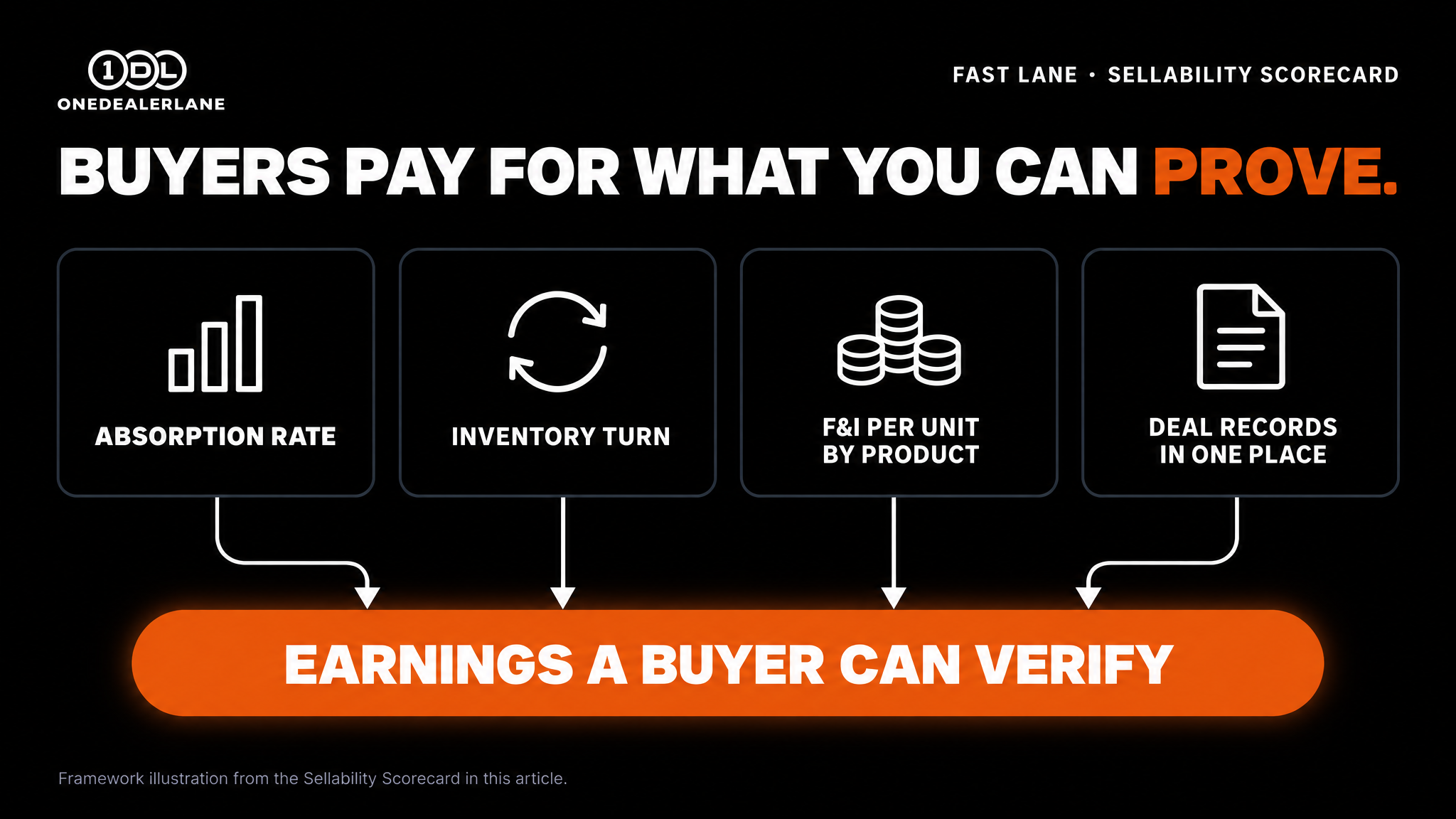
Where does deal data fit in a dealership's value?
Your financial statement shows what the store earned; your deal records show whether it can earn it again. A buyer who sees strong F&I income will ask for penetration by product, by F&I manager and by month. If that answer lives across a CRM, a DMS, paper menus and lender portals, someone builds a spreadsheet during diligence, and every gap becomes a negotiating point.
This is where habits show up. In our field notes from three California stores, the processes worked, but they lived in people's heads, and a buyer pays less for a process that leaves with its owner. See our posts on documented sales processes and the F&I KPIs most dealers don't track.
The Sellability Scorecard
Score each line 0 (you can't show it), 1 (it takes days of work) or 2 (you can show it in an afternoon from your own records). There are no industry benchmarks here on purpose: compare yourself with your own history, your OEM composites or your 20 group.
Area
What a buyer asks
Good evidence (score 0–2)
1. Absorption rate
Does fixed ops cover overhead?
24+ months of absorption, calculated the same way each month
2. Inventory turn and aging
Is the inventory fresh?
Turn by category, an aged-unit list and a reconciled parts count with obsolete stock written down
3. Revenue mix
Where does the gross come from?
Monthly gross by department: new, used, F&I, parts, service
4. F&I per unit by product
Is back-end income repeatable?
PVR and penetration by product and by F&I manager, pulled from deal records, not recaps
5. Deal-time consistency
Is the process repeatable?
Write-up-to-delivery time by month, and the share of deals that used the same menu and forms
6. Deal records in one place
Can diligence verify the numbers?
Each deal's quote, credit app, menu and contracts tied to one deal record
7. Documented process
Will it run without you?
A written sales and F&I process, approval rules, and a manager who runs the desk when you're out
8. Team continuity
Who stays after the sale?
Key-person list and pay plans in writing
Our rule of thumb, not an industry standard: 13 to 16 points means your records are ready for an adviser. Eight to 12, fix the zeros this year. Under 8, start with the records.
Frequently asked questions
How far ahead should I prepare to sell my dealership?
Advisers writing in Powersports Business recommend 12 to 24 months: enough time to reconcile inventory, fix depreciation schedules, take personal expenses off the books and build a record a buyer can verify.
What is absorption rate?
Absorption rate is the share of a dealership's fixed expenses covered by service and parts gross profit. Buyers weigh it heavily because it shows how the store holds up when unit sales slow.
What to do this week
Pull your last 90 days of deals and answer three buyer questions without building a spreadsheet: F&I per unit by product, average write-up-to-delivery time, and how many deals used your menu. Time it. Then fill in the scorecard with your GM and F&I manager and circle every zero.
When this doesn't apply
The scorecard doesn't value real estate, franchise rights or goodwill; that's work for your CPA, broker and attorney. Family transfers still need most of it, since lenders and OEMs review the successor. If you're the buyer, run it on the target store. This is general information, not legal, tax or financial advice.
Where ODL fits
Fast Lane keeps the desk, credit application, F&I menu and contracts on one deal record, which cuts the DMS-to-F&I handoffs where records split. Lines 4 through 6 of the scorecard come from one place, and owners can get answers about PVR, close rates and performance in seconds.
See what your deal records would show a buyer, before a buyer asks. Talk to an ODL Expert.
About the author
Param Ramakrishnan is the CEO of One Dealer Lane. He works with powersports, marine, and RV dealers to connect fragmented sales, credit, and F&I workflows into a single deal record. He writes about dealership operations, retail-finance handoffs, data quality, F&I performance, and the practical process changes that help teams move deals forward without losing accuracy or customer context.
Sources
- Powersports Business, “Another Harley store shuts its doors, this time north of the border” (Oct. 20, 2026)
- Powersports Business, “Longtime Indiana Harley-Davidson dealer to close after 47 years” (Oct. 14, 2026)
- Powersports Business, “Ohio Harley-Davidson dealership closes after nearly 40 years” (Sept. 30, 2026)
- True North Mergers & Acquisitions, “Powersports” industry insights (accessed Oct. 29, 2026)
- Powersports Business, “Selling your dealership: The checklist every owner forgets” (Jan. 6, 2026)
- Powersports Business, “The art and science of preparing your dealership for sale: Part 1” (Sept. 13, 2023)
- Powersports Business, “Sonic expands footprint with five Harley dealership acquisitions” (Apr. 21, 2026)
- Powersports Business, “Kent Powersports dealership group acquired in Central Texas” (Aug. 11, 2026)
Back to Top
Get more from every deal
Sign up for a free trial and start driving higher gross this month. No commitment, just results.
(877) 421-0135