Back
More Units, Less F&I Profit: 5 Warning Signs Behind a Strong Sales Month
By Zac Jones, Head of Sales and Marketing, One Dealer Lane · Approximately a 5-minute read
August 5, 2026
Share:

Retail volume can rise while approval quality, deal structure, reserve, and product attachment weaken. These five F&I warning signs reveal whether a strong powersports sales month is actually producing healthy finance deals — or quietly hiding a softening finance office.
The showroom can have a good month while the F&I office quietly has a bad one. More applications, more originations, and more units delivered can make the top line look healthy — even as approval quality, reserve, and product attachment erode underneath it.
The current market is producing exactly that split. Polaris reported stronger retail activity and healthier dealer inventory while financial-services income declined under higher borrowing costs. Harley-Davidson Financial Services (HDFS) grew second-quarter originations 10% to $940 million — yet revenue fell 55% year over year as the business shifted to a capital-light model. Volume and finance economics are not the same measurement.
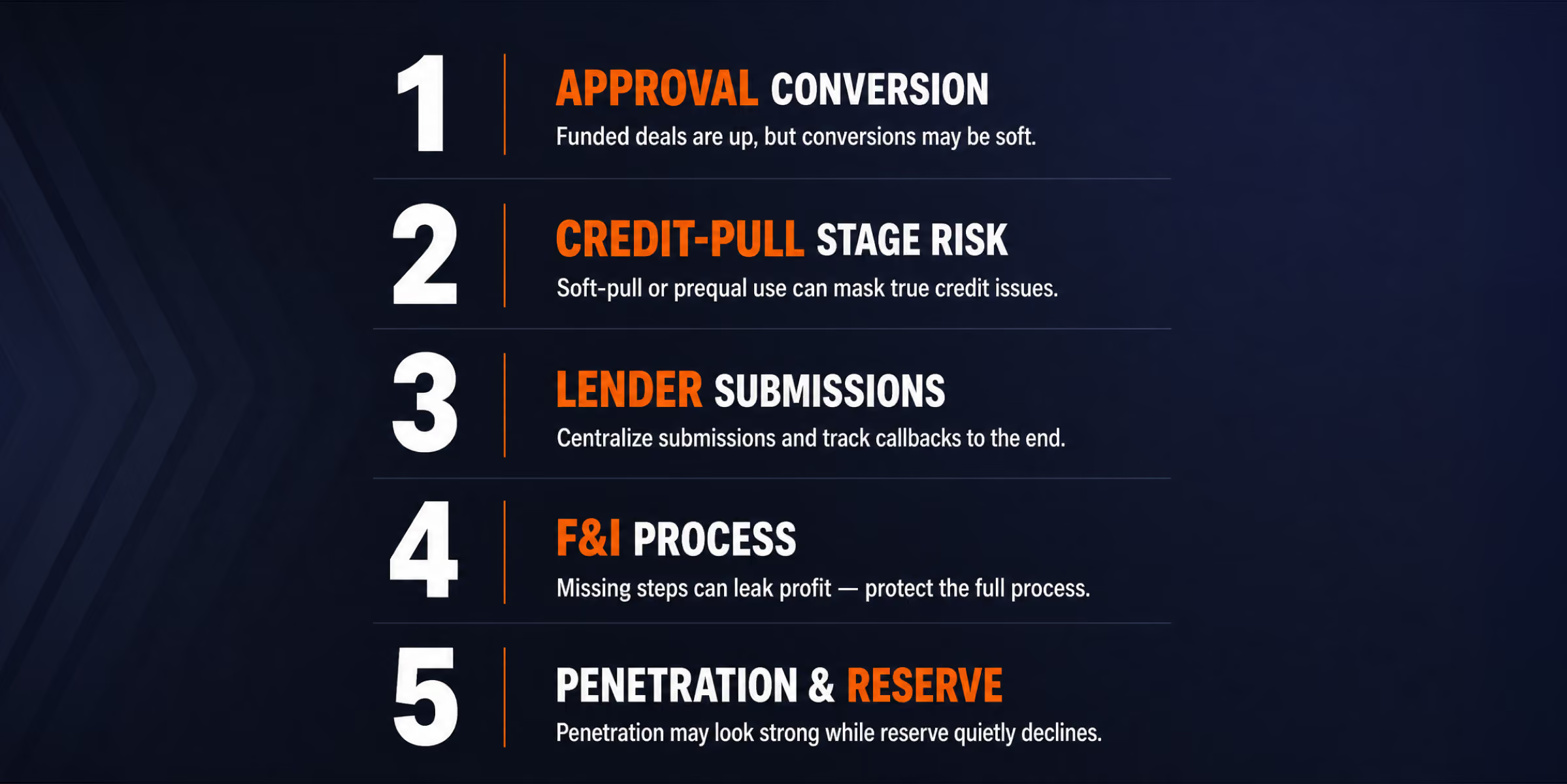
The 5 F&I warning signs behind a strong sales month
Warning 1: Approval and funding conversion
Applications are activity; funded deals are output. Many powersports stores cannot segment results by credit tier because they never pull a bureau before sending the application to a lender. The objection is always cost — every report feels like another expense on a deal that may not close.
A practical policy is not to pull credit on every inquiry. Pull it — with proper customer authorization — once the customer reaches a defined finance stage: an agreed unit and a serious payment or purchase conversation. Where permitted, evaluate soft-pull or prequalification options for earlier screening. Then track pull rate, applications, approvals, approvals that fund, and results by tier.
Warning 2: Shrinking F&I deal-structure room
Watch lender advance, required cash down, stipulation count, and the number of approvals that need a counteroffer. Most powersports stores cannot see these today because each lender lives in a separate portal, and each callback stays trapped there. The store submits the same application repeatedly, then compares approvals from browser tabs, emails, or memory.
The fix is a centralized lender-routing and decision-history tool that records every submission and normalizes each callback — approved amount, rate, term, payment, cash down, stipulations, decline, or counteroffer — inside the same deal.
Warning 3: Term and payment stretch
OEM pricing, tariffs, and borrowing costs can push amount financed higher. Longer terms may preserve the monthly payment and protect unit count, but they also increase total interest, tighten product room, and expose affordability pressure.
Comparing approved term, contracted term, cash down, and first-pencil-versus-funded payment is impossible when the first pencil is paper, lender approvals live in portals, and the final contract only appears in the DMS. You need one versioned deal record that preserves the initial presented structure, each lender callback, the accepted approval, the F&I menu, and the final contracted or funded payment.
Warning 4: Reserve per financed deal
Finance penetration can rise while reserve falls — because of promotional APRs, tighter markup limits, credit mix, or flat-fee lender programs. VisionAST's Q1 2025 powersports benchmark reported record finance penetration of 53% and average bank reserve of $354.89. Those are separate metrics, and they should stay separate on the dealer dashboard.
Warning 5: Products per deal (PPD)
Higher volume can prop up total F&I dollars even while fewer customers buy service contracts, maintenance, theft, or tire-and-wheel coverage. VisionAST reported products per deal rising from 0.57 to 0.74 over six quarters. A reversal in your own store's trend is an early signal — one that shows up well before total gross makes the decline obvious.
The F&I warning scorecard at a glance
Most stores can't measure what their portals trap
There is a hard truth behind this scorecard: dealers cannot manage data they do not capture. A disconnected store has a credit application in one system, bureau data in another, five lender decisions across five portals, a first pencil on paper, a menu in a standalone tool, and the final deal in the DMS. One Dealer Lane is designed to connect that chain. Credit application, bureau-based decision context, lender submissions and callbacks, desking versions, menu selections, and the closed deal can all remain attached to one transaction record — giving the dealer the history required to calculate these warnings instead of estimating them.
Why PVR alone can't diagnose the problem
Do not use total PVR as the only answer. PVR is a combined result of finance penetration, reserve, products, pricing, cancellations, and deal mix. It tells you that performance moved — not which lever moved it.
Build a weekly finance-quality scorecard with five rows: approval/funding, tier and structure, term/payment, reserve, and products. Show current week, trailing four weeks, and the prior-year comparable period. Add one sentence explaining the driver and one action owner. The point is not more reporting; it is earlier intervention.
A strong sales month can also hide operational shortcuts. When the floor gets busy, credit applications may go to the easiest lender, counteroffers may not be worked, menus may be rushed, and products may be skipped. If delivery volume increases while products per deal or reserve per financed deal falls, inspect the process before blaming the market.
Measure deal quality before volume hides it
Current earnings reinforce the need. Polaris has shown higher sales alongside lower financial-services income in multiple quarters. MarineMax reported F&I product revenue down 2.1% year over year. These are company-level results, not dealer benchmarks — but they demonstrate why finance health deserves its own view.
Celebrate the units. Then ask whether those units produced funded, well-structured deals with consistent product presentations and durable gross. A good month is not only what rolled over the curb. It is what remained after the lender, the product contracts, and the chargeback window had their say.
“A strong sales month is not only what rolled over the curb. It is what remained after the lender, the product contracts, and the chargeback window had their say.”
About the author
Zac Jones is Head of Sales and Marketing at One Dealer Lane. He works with powersports, marine, and RV dealers on modernizing the sales and F&I process — from the first online touch through a transparent, customer-facing deal — so a single showroom can win every buyer who walks in, whatever generation they belong to.
A note on sourcing: Public figures are drawn from Polaris, Harley-Davidson Financial Services, MarineMax, Auto Finance News, Powersports Business, and VisionAST benchmark reporting. Metrics without reliable public powersports benchmarks are presented as store-controlled trends, not industry standards.
Sources
- Auto Finance News — Polaris financial services income declines amid interest-rate pressure (July 28, 2026)
- Powersports Business — Polaris raises 2026 revenue outlook as utility sales, dealer health fuel Q2 growth (July 29, 2026)
- Auto Finance News — Harley-Davidson's originations grow in Q2 on strong domestic demand (July 23, 2026)
- Auto Finance News — MarineMax F&I product revenue falls 2.1% YoY (July 24, 2026)
- Auto Finance News — Powersports approval rates decline (June 20, 2024)
- Motorcycle & Powersports News — How powersports dealers are thriving amid industry uncertainty (May 2, 2025)
- One Dealer Lane — The F&I KPIs Most Powersports Dealers Don't Track (But Should)
Back to Top
Get more from every deal
Sign up for a free trial and start driving higher gross this month. No commitment, just results.
(877) 421-0135