Back
One Product Beats No Products: Rethinking the Cash F&I Menu
By Josh Harnish, Customer Success Manager, One Dealer Lane | Approximately 4 minute read
July 29, 2026
Share:

Cash buyers still face breakdowns, tire damage, maintenance and theft risk. The better question is not whether they should see F&I products, but whether a package-and-payment menu is the right way to help them choose.
The customer walks to the desk and says four words that make most dealerships stop selling: "I am paying cash." Here's what usually happens next: the desk notes the lack of a monthly payment, mentally files the deal as lower-margin, and moves to the paperwork. The unit still has tires, electronics, a battery, mechanical risk, and theft exposure. But because it's cash, the F&I presentation disappears.
The problem isn't the customer. It's the presentation. Cash doesn't remove the risk. It changes how the customer evaluates price. The better question isn't whether cash buyers need F&I protection - they do. It's whether a bundled package shown as one lump-sum total is the right way to help them choose.
Cash changes the frame, not the risk
A customer financing a motorcycle usually sees F&I products as a change to their monthly payment: "add GAP, add tire coverage, add service contract—your payment becomes $X." A cash customer sees the entire product price at once - after mentally committing to the unit's out-the-door cost. Adding a multi-product package feels like reopening a transaction that was already done.
That difference is consistent with broader consumer-payment research. Studies by Prelec and Simester, Soman, Raghubir and Srivastava, and Gourville show that payment form, payment timing and temporal reframing can change how consumers evaluate cost and willingness to pay. Those studies are not dealership or powersports research, so they do not prove how a motorcycle buyer will behave. They do support a practical conclusion: a lump-sum cash decision and an incremental-payment decision are not psychologically identical.
Why a package menu can create sticker shock
That is where the standard Good / Better / Best menu can strain. It asks the cash buyer to evaluate several bundled products and one large total. Even if two products are highly relevant, the package price can produce sticker shock and turn the decision into all or nothing.
Fay Myers Motorcycle World surfaced a different approach after a dealership training session influenced by Garage Composites. The requested cash presentation placed each selected product in its own column, explained the product, and showed multiple term and price options. Instead of asking the customer to commit to a complete package, the design allowed the customer to select the one or two products that fit how the unit would be owned and used.
The operating goal was intentionally modest: improve cash-deal penetration by getting a customer to purchase at least one relevant product instead of none. Product work that followed also identified the need for editable product language, multiple terms for the same product, digital selection and a printable version. Those details matter because a cash menu is not simply a finance menu with the payment row removed.
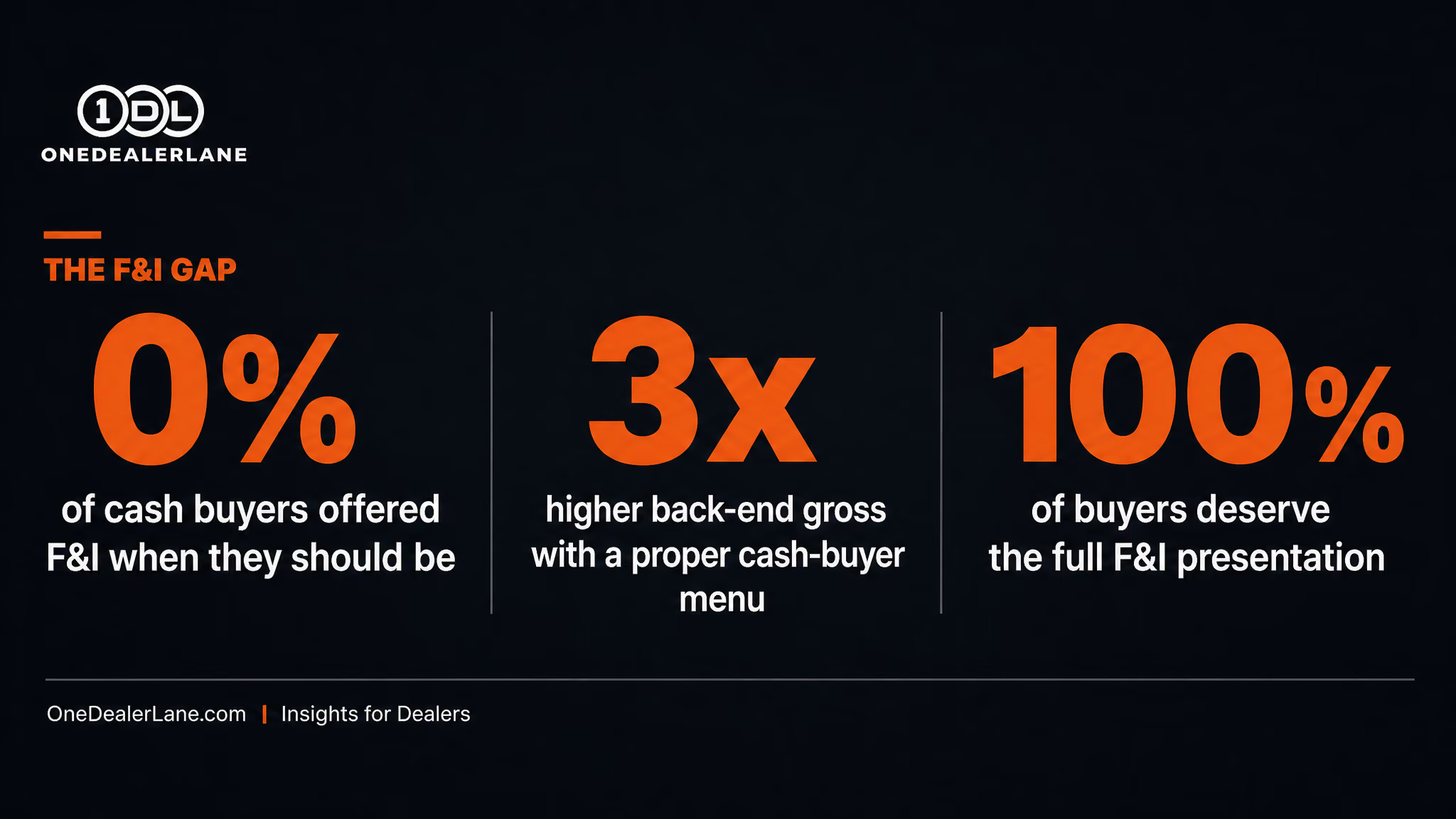
The issue: when you strip the monthly payment from a bundled package and show only the total, the price - not the value - becomes the focus. Even if the customer wants two of the three products, a $3,500 package total can trigger rejection where an incremental-choice menu wouldn't.
What Fay Myers Motorcycle World Did Differently
After a training session that referenced Garage Composites' approach to F&I conversation design, Fay Myers tested a different cash presentation:
- One column per product (not Good/Better/Best packages)
- Plain-language value for each product ("If your bike needs unexpected work, service contracts cover labor and parts; without one, a major repair can cost $2,000+")
- Multiple term and price options for the same product (not locked to one package configuration)
- Multiple term and price options for the same product (not locked to one package configuration)
- A simple decision: "Which one or two products fit how you'll own and ride this bike?"
The operating goal was modest: get cash buyers to purchase at least one relevant product instead of none.
The result wasn't a wholesale shift to package acceptance. It was a cleaner decision frame that respected how cash buyers think.
Same Discipline, Different Frame
The worst cash menu is no menu. The second worst is a finance menu with the payment stripped out.
A different layout is not a weaker process. Every cash customer still gets:
- A consistent presentation of every eligible product
- Clear explanation of value in ownership terms
- Options to compare across terms and prices
- A documented record of the presentation
Consistency matters for oversight. It also matters for compliance. A menu by itself doesn't make you compliant - product eligibility, disclosures, pricing, and state requirements still need their own controls. But a digital presentation record supports training and regulatory review.
How to run the cash-menu conversation
Forget the package-first approach. Start with ownership. Ask how the customer will use the unit, how long it will be kept, where it will be ridden or stored and which unexpected cost would be most disruptive. Then present eligible products individually with plain-language value, the available terms and the full cash price. Let the customer compare and select without turning the conversation into a forced package decision.
A practical cash presentation can follow five steps:
- Confirm the unit and intended use
"So you're riding this locally, or are you planning trips? How long do you usually keep a bike?" - Present every eligible product
Don't pre-decide that a cash buyer won't want service contracts, tire-and-wheel coverage, prepaid maintenance, or theft protection just because they're paying cash. Show them. - Explain each product in ownership terms
Not features. Outcomes. "Tire coverage means you don't have to budget for unexpected flat repair or replacement while you own it" beats "includes tire and wheel damage protection." - Show multiple term and cash-price choices
One-year, three-year, and five-year options at different price points for the same product. Let them compare. "Service contract is $899 for one year or $2,400 for three years - whichever fits how long you'll own it." - Record selections and declinations**
A digital record of what you presented, what terms you showed, and what they chose (or declined) gives you compliance documentation and training data.
Measure cash separately from financed deals
Don't judge a new cash menu only by total F&I gross. Track these metrics separately from financed deals:
- Cash-menu presentation rate (% of cash deals shown the menu)
- At-least-one-product close rate (% of cash customers buying 1+ products)
- Products per cash deal (average number purchased)
- Cash F&I revenue per unit
- Penetration by product (% of cash buyers selecting tire coverage, service contracts, etc.)
Why? If cash buyers select one or two products more often while per-deal gross stays lower than financed deals, the menu is working exactly as designed. You're not competing with financed deals on bundle size. You're converting cash buyers from zero products to one or two.
One cash customer choosing a service contract and tire coverage instead of nothing is a win - even if it's lower gross than a financed package.
The real test
Does the customer walk away with protection they wouldn't have purchased otherwise? If yes, the menu works. If the goal is to force cash buyers into the same gross-per-deal as financed customers by bundling everything, you'll create the same sticker shock you're trying to avoid. Keep them separate.
“The goal of a cash menu is not to sell the entire package. It is to help the customer choose the one or two products that fit how the unit will actually be owned.” – One Dealer Lane
Present every eligible product to every customer - with a decision frame that fits how the customer is paying.
One Dealer Lane brings desking, credit, F&I menus, and eSignature into a connected workflow.
Ready to Build a better F&I Workflow?
See how cash-menu design integrates with your real-time KPI dashboard. Request a 20-minute walkthrough.
About the author
Josh Harnish is a Customer Success Manager at One Dealer Lane with six years of dealership training experience and a decade of automotive retail leadership. He works alongside A2Z Sync, a leading automotive technology company, and brings operational expertise to powersports F&I workflow design.
Sources
- Internal research - Fay Myers and One Dealer Lane Alternate Cash Menu PRD, correspondence, Teams discussions, and roadmap transcripts (January-July 2026)
- Garage Composites - dealership training and 20 Clubs
- Prelec and Simester - Always Leave Home Without It: A Further Investigation of the Credit-Card Effect on Willingness to Pay (Marketing Letters, 2001)
- Soman - Effects of Payment Mechanism on Spending Behavior: The Role of Rehearsal and Immediacy of Payments (Journal of Consumer Research, 2001)
- Raghubir and Srivastava - Monopoly Money: The Effect of Payment Coupling and Form on Spending Behavior (Journal of Experimental Psychology: Applied, 2008)
- Gourville - Pennies-a-Day: The Effect of Temporal Reframing on Transaction Evaluation (Journal of Consumer Research, 1998)
- One Dealer Lane - The F&I KPIs Most Powersports Dealers Don't Track (But Should)
- One Dealer Lane - Your F&I Menu Was Built for a Camry, But You Sell Side-by-Sides
Back to Top
Get more from every deal
Sign up for a free trial and start driving higher gross this month. No commitment, just results.
(877) 421-0135