Back
RideNow Went All-In on Price. What Should Every Dealer Learn?
By Zac Jones, Head of Sales and Marketing, One Dealer Lane | Approximately 5-minute read
October 14, 2026
Share:

A customer finds a side-by-side online at one price, then sees freight, setup, and a pre-loaded add-on on the worksheet at the desk. That gap is getting harder to defend, and a publicly traded powersports retailer has now told investors what closing it cost.
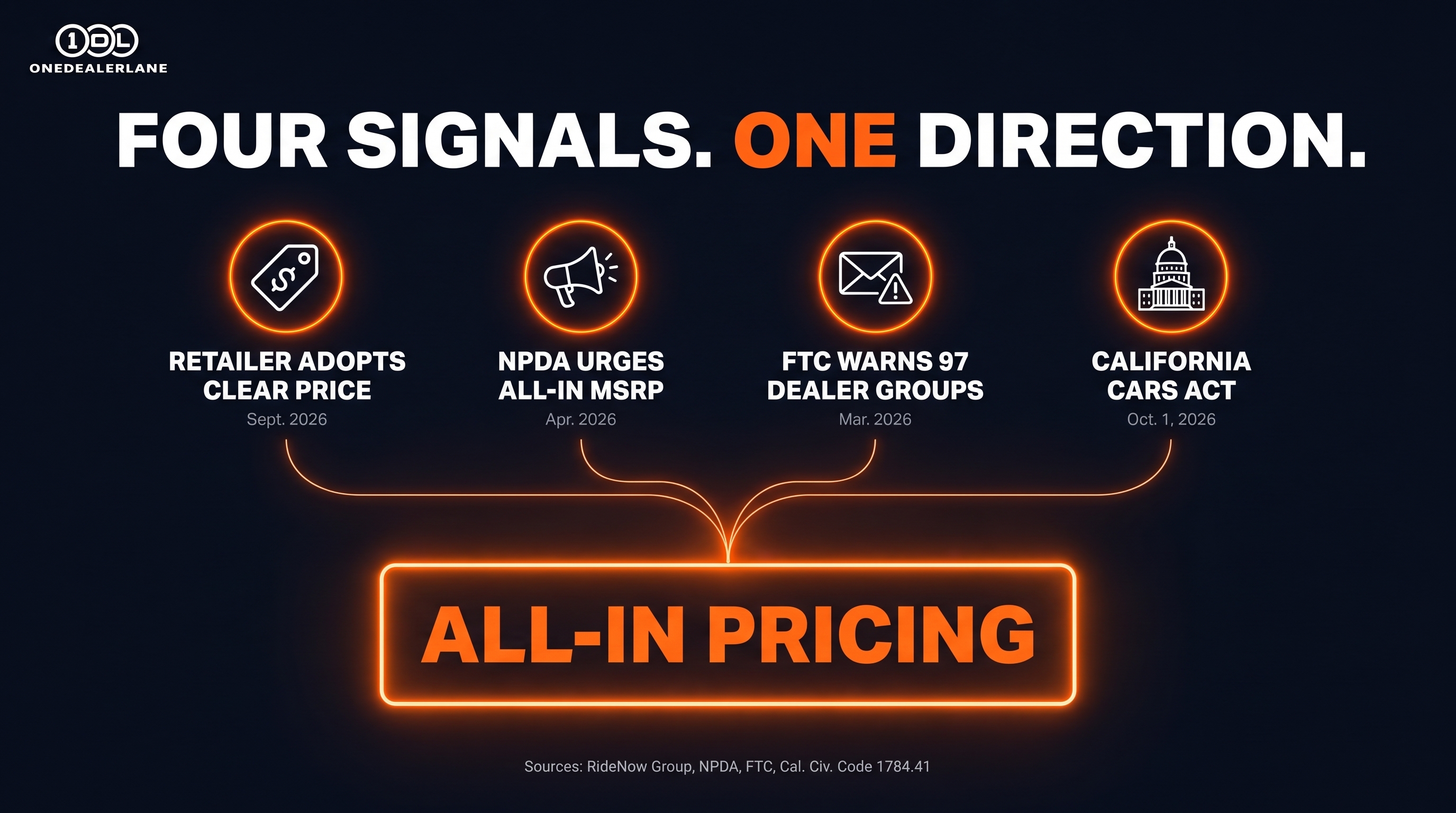
On September 28, 2026, RideNow Group said its new FTC-compliant pricing model, Clear Price, had a short-term negative impact on its August results. In March, the FTC warned 97 auto dealership groups that the prices they advertise must be the total price, including all mandatory fees. And California's CARS Act took effect October 1, 2026.
The direct answer
For powersports dealers, the lesson is that all-in pricing moves profit pressure off the advertised price and onto process. RideNow adopted FTC-compliant pricing and took a short-term hit to August results. Dealers who make the same move should expect less room to pad the front end, and should protect gross with a consistent, documented, and disclosed sales and F&I process.
Key takeaways
RideNow Group said its FTC-compliant Clear Price pricing model had "a short-term negative impact on our August results" (RideNow press release, September 28, 2026).
NPDA asked OEMs in April 2026 to move to an all-in MSRP that includes the applicable freight or destination charge (NPDA white paper, April 23, 2026).
The FTC warned 97 auto dealership groups in March 2026 that advertised prices must be the total price, including all mandatory fees.
California's CARS Act took effect October 1, 2026, and requires total-price disclosure in covered ads and in a dealer's first written communication about a specific vehicle (Cal. Civ. Code §1784.41).
What did RideNow tell investors about all-in pricing?
RideNow said it introduced Clear Price, its FTC-compliant pricing model, during the quarter. In a September 28 press release announcing a $220 million term loan refinancing, Chairman and CEO Michael Quartieri said the company was "one of the early adopters of FTC compliant pricing, which had a short-term negative impact on our August results."
RideNow did not disclose the size of that impact. The direction matters more: a public powersports retailer chose transparency and told investors it cost something up front.
Is there a new federal pricing rule for powersports dealers?
No. The Fifth Circuit vacated the FTC's CARS Rule in January 2025, and the FTC formally withdrew it in February 2026. What exists in 2026 is enforcement and staff guidance under Section 5 of the FTC Act, so far aimed at auto dealers. Section 5's ban on deceptive pricing applies to all businesses, including powersports dealers.
The auto cases show where enforcement is heading. In March 2026, the FTC warned 97 auto dealership groups about advertised prices that leave out mandatory fees. In April, the FTC and Maryland's attorney general announced a settlement with Lindsay Auto Group: more than $75 million in charges may be eligible for refunds, and Lindsay will pay a $3.1 million civil penalty.
Powersports has its own warning. NPDA's April 2026 white paper said that separating mandatory costs from the advertised MSRP creates a price discrepancy that invites regulatory consequences. It called on OEMs to move to an all-in MSRP that includes the applicable freight or destination charge, and to adopt a formal reimbursement model for required setup, assembly, inspection, and delivery preparation.
What does California's CARS Act change?
Since October 1, 2026, California dealers must show a vehicle's total price in covered ads that reference a specific vehicle and in their first written communication about it. When a dealer makes a written representation about an add-on, it must also state in writing that the add-on is optional and not required to buy the vehicle. Dealers must keep a copy of that first written communication for at least two years.
Motorcycles are covered by those total-price and add-on rules. The law excludes motorcycles from its definition of a "used motor vehicle," which appears to take them out of the three-day cancellation right on used vehicles priced at $50,000 or less. Coverage for off-highway vehicles and RVs depends on registration and weight rules. Confirm both points with counsel.
Where does gross come from after the front end goes all-in?
When the advertised price includes every mandatory fee, gross depends on running the same disclosed process on every deal.
Old habit
Transparent version
Why it protects gross
Freight and setup added at the desk
Mandatory fees built into the advertised price
No surprise at signing that kills the deal
Add-ons pre-loaded on the worksheet
Add-ons offered separately and marked optional
Customers trust the price, so they keep listening
F&I products pitched only to some buyers
One menu presented to every customer
Penetration grows from consistency, not pressure
Paper menus and verbal disclosures
Digital records of what was shown and declined
Proof of process if a customer or regulator asks
Framework illustration, not legal advice.
When every customer sees the same price logic and the same F&I menu, you sell products on value instead of surprise, and the store can show exactly what it offered. California now requires dealers to keep ads, first communications, and pricing disclosures for two years. Keeping that record is good practice everywhere else, too.
What should you do this week?
- Pull your top 20 online listings and check that each advertised price includes every mandatory fee.
- Write down your fee policy: what's mandatory, what's optional, and who can change either.
- Remove any add-on that's pre-loaded on the worksheet without the customer choosing it.
- Make one F&I menu the standard for every deal, cash and finance.
- If you sell in California, review your first-response emails and texts with counsel.
Menu Lane, the digital F&I menu on the ODL platform, helps make that consistency the default. Every customer sees the same digital menu, and Menu Lane captures each decision in one digital workflow, so the store has a record of what it presented. ODL reports that dealers who use the ODL menu consistently on every deal have seen double the F&I gross.
Want to walk through a transparent, consistent F&I process for your store? Talk to an ODL Expert.
Quick answers
Does the FTC require all-in pricing for powersports dealers?
The FTC has no powersports-specific pricing rule. Its 2026 warning letters and staff FAQs on pricing address auto dealers under Section 5 of the FTC Act, and the staff FAQs are not binding. Section 5's ban on deceptive pricing applies to all businesses, including powersports dealers. NPDA has urged powersports OEMs to move toward all-in MSRP pricing anyway.
Does California's CARS Act apply to motorcycles?
Yes, for its total-price and add-on rules. The law excludes motorcycles from its definition of a "used motor vehicle," which appears to take them out of the three-day cancellation right. Confirm that point, and off-highway vehicle and RV coverage, with counsel.
Will all-in pricing lower my gross?
It can in the short term, as RideNow reported for August. Dealers can protect gross by presenting F&I products consistently and transparently on every deal.
This article is for general information and is not legal advice. Consult counsel about your state's requirements.
About the author
Zac Jones is Head of Sales and Marketing at One Dealer Lane, where he focuses on pricing, compliance, and marketing for powersports, marine, and RV dealers. He brings two decades of automotive retail experience, from the retail floor to leadership roles at Cox Automotive, Tekion, and AutoFi.
Sources
- RideNow Group, Inc., "RideNow Group, Inc. Announces $220 Million Senior Secured Term Loan Refinancing" (September 28, 2026)
- NPDA, "Why Transparent Pricing Must Start Upstream to Protect Powersports Dealers" (April 23, 2026)
- Federal Register, Withdrawal of the CARS Rule, 91 FR 6507 (February 12, 2026)
- FTC, "FTC Warns 97 Auto Dealership Groups About Deceptive Pricing" (March 13, 2026)
- FTC, "FTC, Maryland Attorney General Secure Full Refunds, Additional Penalties Against Lindsay Auto Group" (April 2, 2026)
- FTC staff, "Automobile Industry Pricing Transparency: FAQs" (September 2026)
- California Civil Code §1784.31 (definitions; motorcycle exclusion from "used motor vehicle")
- California Civil Code §1784.41 (total price; add-on disclosure; record retention)
- California DMV, "California Combating Auto Retail Scams (CARS) Act" (effective October 1, 2026)
Back to Top
Get more from every deal
Sign up for a free trial and start driving higher gross this month. No commitment, just results.
(877) 421-0135