Back
Your AI Answers Customers Now. What Should It Decide Alone?
By Param Ramakrishnan, CEO, One Dealer Lane | Approximately 5-minute read
November 18, 2026
Share:
Key takeaways
A 2026 SAS study with IDC of 2,699 decision-makers in 28 countries found that 97.2% of users override AI-generated recommendations in at least some cases.
SAS reports that the number one reason employees override AI is that the AI could not explain its decision.
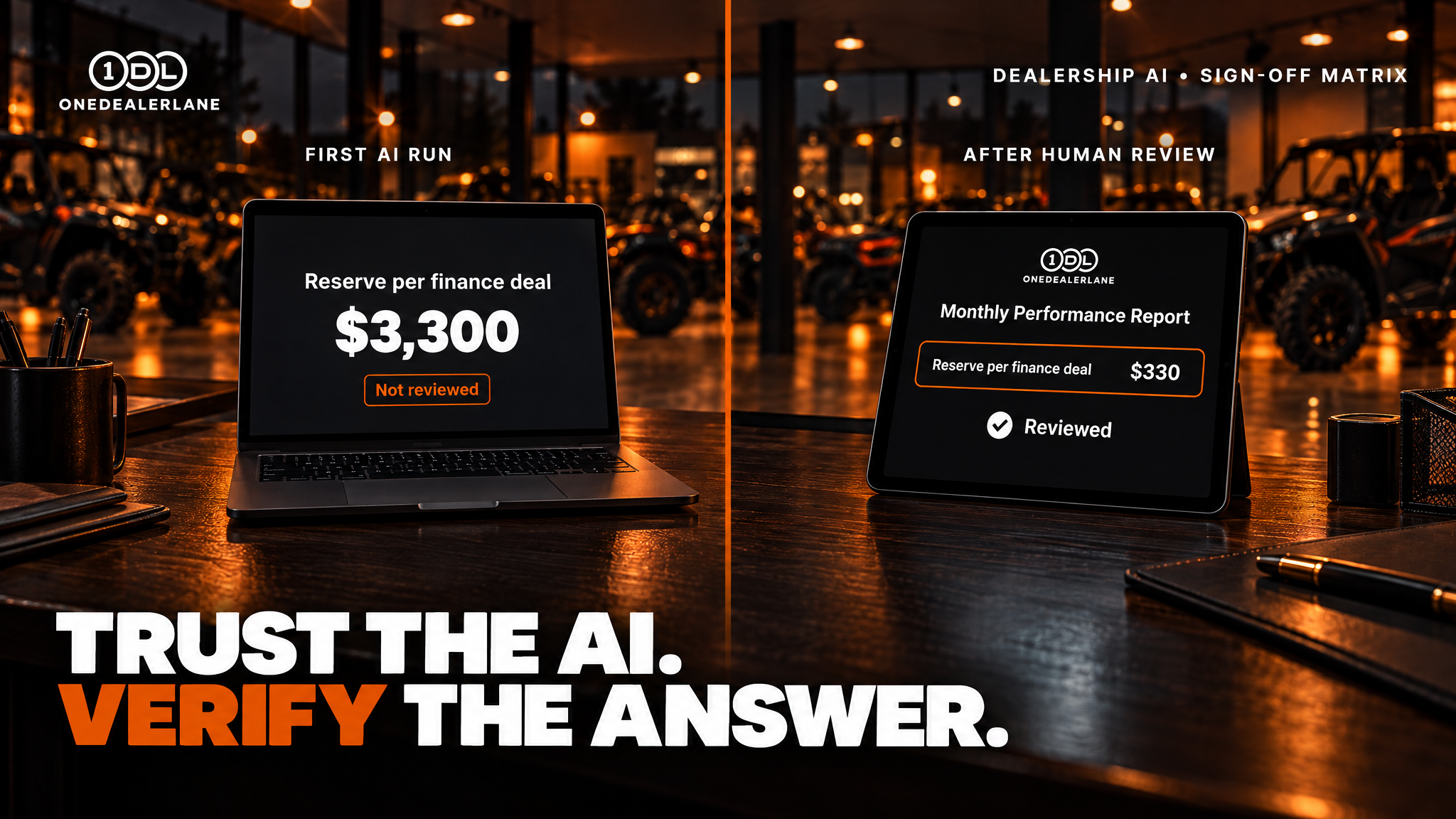
On an early run, an AI-built report at One Dealer Lane overstated one store’s reserve per finance deal roughly tenfold: about $3,300 against an actual figure of about $330.
New York City’s consumer agency sued CarGurus on Oct. 15, 2026, alleging consumers “encounter further deception” when they use the site’s AI chatbot. These are allegations, not findings.
The direct answer
Dealership AI should decide alone only when the answer is low-stakes, comes straight from a live record and is easy to correct. Acknowledging a lead after hours qualifies. Quoting a payment, valuing a trade or telling a customer anything about credit does not. For those, AI can draft and a named person approves, or a person does the job. The decision that matters is who owns each answer.
Why are dealers being told to verify AI now?
The trade press and regulators are pointing at the same gap. Powersports Business advised dealers on Nov. 11, 2026, to “trust the technology, but verify its work.” The column leans on the SAS study, which surveyed banking, insurance, life sciences and public-sector organizations, not dealerships.
At least one regulator already treats an AI answer as the company’s answer. In its CarGurus release, New York City’s Department of Consumer and Worker Protection said its enforcement covers “representations made by chatbots and other agentic systems.” CarGurus is an auto marketplace, and the case is unproven. The lesson still travels to a powersports, marine or RV store: what your chatbot says, you said.
Here is what I see dealers get wrong. They judge AI by how confident the answer sounds, and they switch it on in auto mode without testing it. An AI answer is only as good as the logic behind it and the data under it. You don’t know either one is right until you have checked real outputs against numbers you already know.
Which answers can AI give on its own?
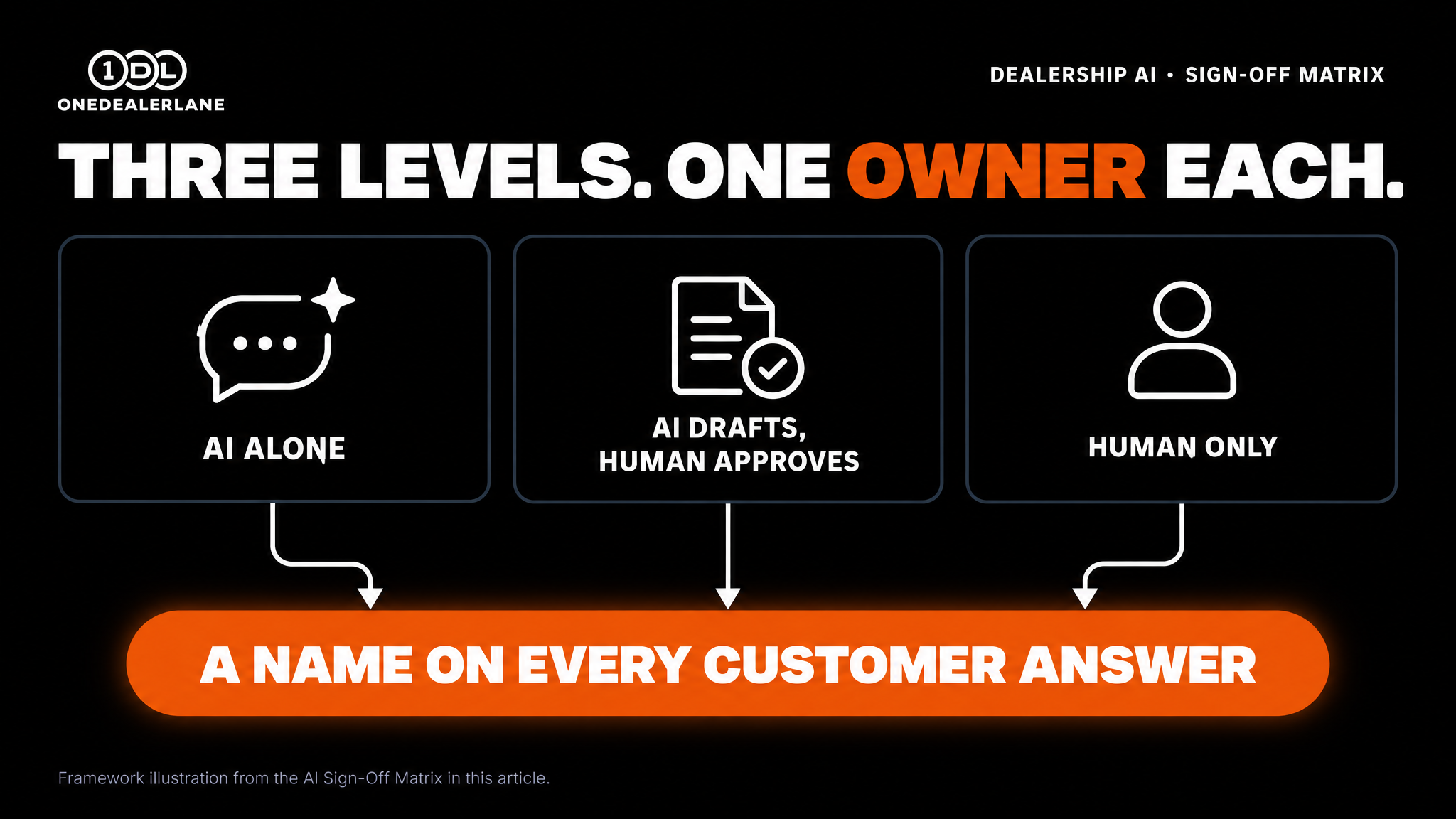
The AI Sign-Off Matrix sorts eight common tasks into three levels and puts an owner on each one.
The AI Sign-Off Matrix
Task
Level
Owner and rule
After-hours lead acknowledgment
AI alone
BDC or sales manager. AI confirms receipt and books a callback.
Inventory availability
AI alone
Inventory manager. AI answers only from the live inventory feed.
Advertised price
AI alone*, read-only from the live listing
Sales manager. Any discount, fee or out-the-door question goes to a person.
Payment estimate
AI drafts, human approves
Desk manager. No payment reaches a customer without a rate, term and down payment a manager approved.
Trade value
AI drafts, human approves
Used-unit manager. AI may gather details. A firm number waits for an inspection.
F&I product recommendations
AI drafts, human approves
F&I manager. A person presents every product, and the customer chooses.
Credit messaging
Human only
F&I manager. AI never tells a customer they are approved, declined or why.
Adverse-action notices
Human only
The creditor’s compliance process. Have counsel review how notices are produced.
* Only after the inventory manager has validated that the inventory feed to your website calculates the advertised price accurately under the FTC’s pricing guidelines. See our article on all-in pricing.
This is a starting point for a store policy. It is not legal advice.
Two tests sit behind every row. Can the answer be checked against one record? Can a mistake be fixed with an apology? If either answer is no, a person signs. Price is where consistency matters most, as we covered in RideNow Went All-In on Price.
None of these tasks should start at “AI alone” on day one. Before a task moves there, it has to pass an eval set and a monitored trial period. Evals are a fixed set of real questions with known right answers, run before launch and again after every change.
Who owns the answer when AI gets it wrong?
A named person, decided in advance. Credit is the clearest case. Regulation B says the reasons in an adverse-action notice “must be specific and indicate the principal reason(s) for the adverse action.” A system that cannot explain itself cannot meet that standard.
We keep a checkpoint on our own work. ODL’s monthly dealer performance reports are built with AI-generated code, and a person reviews the first runs and checks them for accuracy. On an early run, one store’s report showed reserve per finance deal at about $3,300. The store’s actual figure was about $330.
Two problems were behind it. The AI-written code counted the total finance charge, all the interest over the life of the loan, as the dealer’s reserve. Fixing that exposed a data problem at the store: financed deals were entered without the lender’s buy rate, so the DMS recorded almost no reserve. The first runs are where you find both your bugs and your data problems. The output depends on the record behind it, a point we made in The Lender Already Automated Its Yes.
Quick answers
What should a dealership let AI decide without a human?
Low-stakes answers that come from a live record and are easy to correct: lead acknowledgment, in-stock status and the advertised price. Payments, trade values and F&I products need a person’s approval. Credit outcomes stay with people.
Is a dealer responsible for what its chatbot says?
Plan as if the answer is yes. New York City’s consumer agency says its enforcement covers “representations made by chatbots and other agentic systems.” Ask counsel how your state treats it.
Can AI send an adverse-action notice?
Not on its own judgment. Keep the creditor’s compliance process and counsel in charge.
What to do this week
- Start AI where a person reads the output before anyone acts on it: reporting and internal analysis. Keep a short list of known-good numbers to check against.
- Ask your own chatbot for a price, a payment, a trade value and “am I approved?” Save the answers. Those questions are your first evals.
- Put a name beside each row of the matrix, and rerun the evals after every vendor update.
When this doesn’t apply
Don’t let AI decide anything you can’t check against a record. And if getting AI to do a task takes longer than doing it by hand, do it by hand. We have made that call internally too. The survey evidence is cross-industry, so read it as direction, not a dealership benchmark.
Where the ODL platform fits
ODL uses AI where a person reads the output before acting. In the ODL platform, managers can get answers about PVR, close rates and performance in seconds, and dealers get a monthly performance report built from their own DMS and ODL deal data. Fast Lane brings Quick Lane, Sales Lane and Menu Lane together on one platform, so those answers come from one deal record.
Ask how the ODL platform turns your own deal data into answers your managers can check. Talk to an ODL Expert, or call (877) 421-0135.
About the author
Param Ramakrishnan is CEO of One Dealer Lane. He previously held leadership roles at AppOne, Wolters Kluwer, Reynolds & Reynolds and A2Z.
Sources
- Powersports Business, Brendan Baker, “AI in the dealership: Trust, but verify” (Nov. 11, 2026)
- SAS, “Organizations with trustworthy AI practices are 15 times more likely to see strong ROI, per study findings” (September 2026; Data and AI Impact Report, research by IDC)
- NYC Department of Consumer and Worker Protection, “Mamdani Administration Sues CarGurus For Deceiving New Yorkers With AI Chatbot and Hidden Junk Fees” (Oct. 15, 2026)
- Consumer Financial Protection Bureau, Regulation B, 12 CFR 1002.9, Notifications (current version, viewed Nov. 13, 2026)
Back to Top
Get more from every deal
Sign up for a free trial and start driving higher gross this month. No commitment, just results.
(877) 421-0135