Back
Used RV Prices Are Up 23%. Should Your Winter Trade Pay Book?
By Zac Jones, Head of Sales and Marketing, One Dealer Lane | Approximately 5-minute read
November 18, 2026
Share:
Key takeaways
National Powersport Auctions (NPA) reports in its November 2026 RV report that RV and camper average wholesale prices are 23% above year-ago levels, while easing 6% against the prior three-month average.
NPA says the yearly gain came on thinner volume and a higher-value mix of units, “a shift in what sold rather than a surge in demand.”
NPA tells dealers to “be cautious with book values when taking trades,” because auction values in most RV categories remain below J.D. Power book values.
San Francisco Fed President Mary Daly told CNBC on Nov. 6, 2026, “My expectation is we're going to have to tighten policy further,” which would make each day of winter carry cost more.
The Direct Answer
Usually, no. An RV trade-in value set in November should start from what the unit is likely to bring at wholesale in spring, minus what it costs to carry until then. Book is a reference, not an offer. NPA reports that auction values in most RV categories still sit below J.D. Power book values. A store that pays book in winter pays above the market, then pays again to wait.
Does a 23% jump mean your trade is worth more?
Not by itself. NPA's November 2026 RV Pre-Owned Report puts RV and camper average wholesale prices 23% above a year ago. The same report says the gain came on thinner volume and a higher-value mix of units. In NPA's words, it reflects “a shift in what sold rather than a surge in demand.”
The short-term direction matters more at the desk. Prices eased 6% against the prior three-month average, and NPA expects retail and wholesale traffic to slow until spring. The unit in front of you did not gain 23%. The mix at auction changed. NPA footnotes these figures to its September 2026 Market Report, and they cover RVs and campers only.

Why is book the wrong starting point in winter?
Book assumes a normal selling window, and a November trade does not have one. NPA's advice is direct: “Be cautious with book values when taking trades, as auction values in most categories remain below JD Power book values.”
A trade taken today is not sold at today's prices. It sits through the slow months while the store pays for money, storage and winterization. NPA gives auction buyers the same rule: set a maximum bid, “factoring in carry cost through the winter.” Our earlier post, You Didn't Buy a Trade. You Bought 90 Days of Dead Inventory, covers choosing the exit path before you own the unit.
Here is the miss I see. A store appraises a November trade off book and today's retail, then sits on it four to five months. By spring the carry, recon and price drift have eaten the gross, and floorplan charges cost the store every day in between. The number has to start from what the unit will actually bring when it sells, not from what it is worth “if you find the right buyer.”
The pattern is familiar: a store gives book on a winter trade to save the deal, then wholesales it in March for less than ACV plus what it cost to carry. That is a good way to go out of business.
What does a winter trade cost to carry?
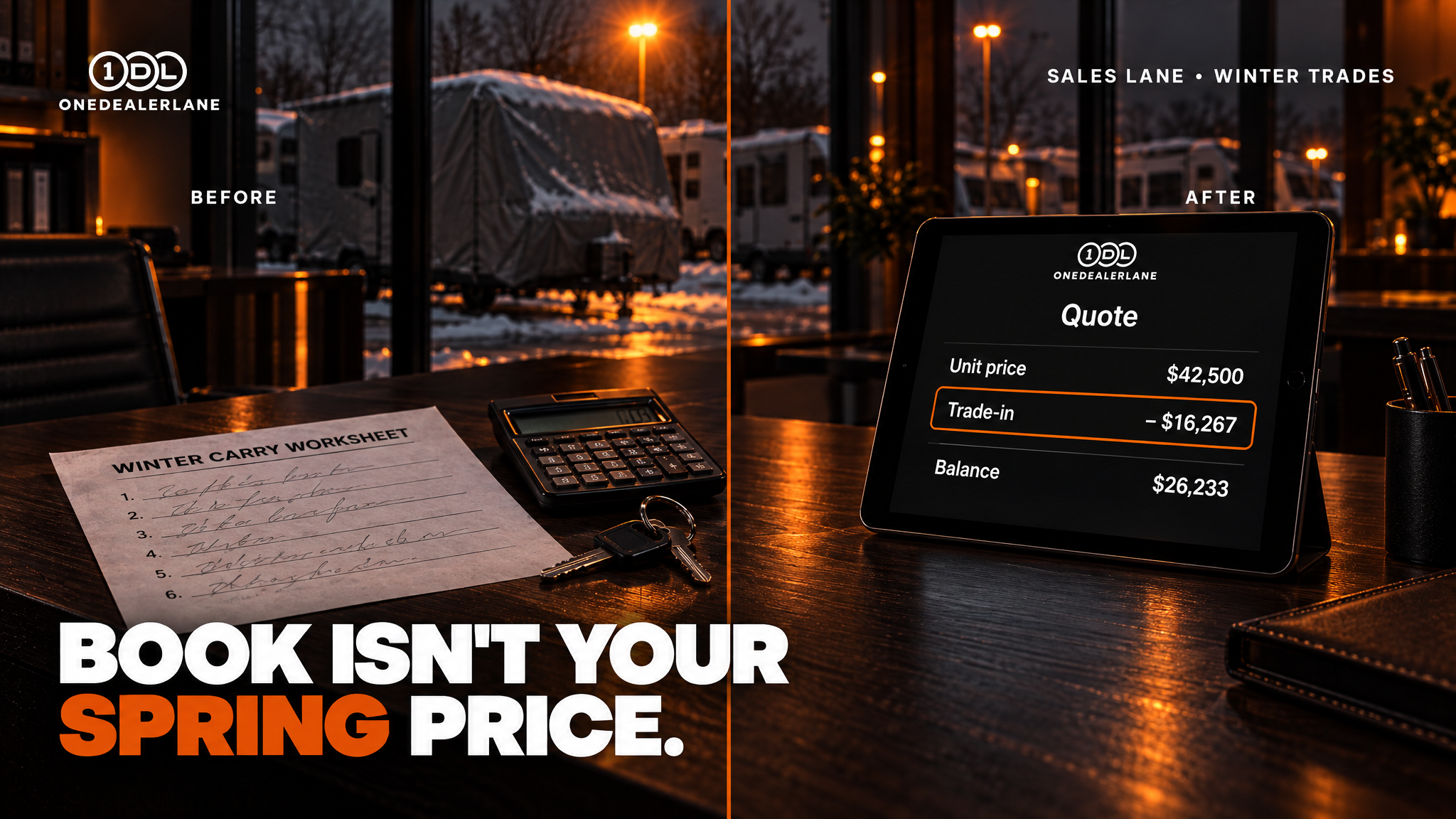
More than most desks count. The Winter Carry Worksheet turns the wait into a number. Start with the expected spring wholesale exit, because wholesale is the floor if the unit does not retail. Subtract each cost of holding it. What remains is the maximum actual cash value (ACV) the desk can defend to the customer, line by line.
The Winter Carry Worksheet
Line
How to figure it
Example
1. Expected spring wholesale exit
Recent auction results for like units, not book
$18,000
2. Days until spring retail
Today to the date your spring traffic returns
120 days
3. Cost of money
Line 1 × your annual rate ÷ 365 × Line 2 (9% used here)
− $533
4. Storage and winterization
Your actual cost per unit for the season
− $300
5. Recon to retail-ready
Written estimate from service, done before spring
− $900
6. Maximum ACV
Line 1 minus Lines 3, 4 and 5
$16,267
All figures are illustrative, not market data. Use your own rate, costs and auction results.
In this example, carry and recon take $1,733 off the top before the store earns a dollar. If rates rise, Line 3 grows. Daly said on Nov. 6 that “more is likely to be needed.”
My recommendation: start by asking how long you usually hold this type of unit. Recent sales history helps, but the season matters more than recent profitability. Then work ACV backward from the spring exit, minus carry and recon, and show the desk the math so they can defend it. Keep the worksheet in the deal file, and show the customer the lines when they ask why the number is under book.
Seasonality is real. One of the stores we work with runs from 62 units in February to 115 at peak.
Quick Answers
Should an RV dealer pay book value for a trade-in during winter?
Usually not. NPA reports that auction values in most RV categories remain below J.D. Power book values, and a winter trade also carries holding costs until spring. Start from the expected spring wholesale exit, then subtract carry and recon.
Does the same approach work for boats and powersports?
Same approach, different calendar. NPA's figures cover RVs and campers only, and the exit timing differs by market. A boat or a snow-belt motorcycle taken in trade in November carries the same kinds of cost, so run the worksheet with your own numbers and your own selling season. For powersports trade values by segment, see The Trade-In Is Where Powersports Gross Goes to Die.
What to do this week
- Pull your last 10 winter trades. Compare the ACV you paid with what each unit brought and how long it sat.
- Ask your office for your real daily cost of money per $10,000 of used inventory.
- Get one storage and winterization cost per unit from service.
- Decide who signs off when a trade is appraised above Line 6.
When this doesn't apply
I wouldn't follow the worksheet on a fast-turn model you can retail inside 30 days, or when the trade is what makes a strong new-unit deal happen. Skip the carry math, too, when the trade is pre-sold or a buyer is waiting, or when you will wholesale it right away. In that last case, today's auction value is your number. The 23% and 6% figures are RV data from one auction company, so treat them as a signal, not a price guide.
Where the ODL platform fits
A defensible trade number only helps if the desk can see what it does to the deal. In the ODL platform, Sales Lane keeps the trade on the same desking worksheet as the rest of the deal, so a manager can see how a change in ACV moves gross before the number reaches the customer. Sales Lane does not calculate carry cost. That part is the worksheet above. With Fast Lane, the same deal record carries from the desk into F&I.
Reach matters as well. If your store can work a deal remotely, a seasonal unit has more markets to sell into. If it can't, you may sit on that unit until the season turns. If lower unit volume is the bigger worry, read RV Shipments Are Down 15%. Can F&I Carry the Gross?
See how Sales Lane keeps the trade, the payment and the gross on one worksheet. Get a Platform Walkthrough, or call (877) 421-0135.
About the author
Zac Jones is Head of Sales and Marketing at One Dealer Lane. He brings two decades of automotive retail experience, including leadership roles at Cox Automotive, Tekion and AutoFi, and now works with powersports, marine and RV dealers on their sales and F&I process.
Sources
Back to Top
Get more from every deal
Sign up for a free trial and start driving higher gross this month. No commitment, just results.
(877) 421-0135