Back
Same Deal, Two Gross Numbers? Check How Your Rebates Are Booked
By Param Ramakrishnan, CEO, One Dealer Lane | Approximately 6-minute read
November 19, 2026
Share:

Key takeaways
KYMCO’s Year-End Choice Sales Event runs Oct. 15 to Dec. 31, 2026, and its ATV coupons, worth up to $600, “must be redeemed and claimed by Dec. 31” (Powersports Business, Oct. 28, 2026).
A desked estimate and the finalized DMS deal can show different gross on the same deal, even when the final accounting is correct.
Consultant Forrest Flinn wrote in Powersports Business (Nov. 8, 2019) that every rebate receivable item over 30 days old “should require research and explanation.”
In Flinn’s experience, some manufacturers only deal with rebate errors within 90 to 120 days, so a December mistake can’t wait for spring.
The direct answer
Should an OEM rebate change a dealer’s front-end gross? It depends on which kind of OEM money it is. Customer cash and dealer cash affect a deal differently. Customer cash applied upfront reduces the customer’s payment, while a valid OEM reimbursement offsets that reduction. Genuine dealer cash benefits the dealership and increases economic gross when recognized once. The dealer may retain that benefit or pass some of it to the customer as a discount. Passing it on reduces gross relative to keeping it; passing it all on offsets the incentive benefit. Missing the incentive understates gross, while recognizing it twice overstates gross.
What are the two kinds of OEM money?
Most confusion starts with treating them as one thing. Customer cash also settles two ways, so separate who benefits from who the OEM pays.
Customer cash vs. dealer cash
Customer cash, applied through the dealer
Customer cash, paid directly to the customer
Dealer cash
Who benefits
The customer
The customer
The store
Who the OEM pays
The dealer, as reimbursement
The customer, after a mail-in or online claim
The dealer
Who decides
The OEM program terms and the customer’s permitted election
The OEM program terms and the customer’s permitted election
The dealer: keep it as margin or pass it on
How to book it
For an eligible customer rebate validly assigned to the dealer, apply it once toward the customer’s balance and record the OEM reimbursement still due. Customer funds actually received are a payment, not an OEM receivable. Follow program, lender and applicable state requirements.
If the customer keeps the later OEM payment, leave the deal balance unchanged; there is no dealer receivable or cost credit. Actual funds the customer contributes can reduce the balance as a payment. An eligible assignment follows the dealer-reimbursement treatment, subject to program and lender rules.
Recognize the earned dealer incentive once, whether retained or passed on as a discount. Record a receivable only for money still owed by the OEM. If the incentive is already reflected in unit cost or an existing credit, do not add it to gross again.
What goes wrong
It is never claimed, or it is counted twice: once as a rebate credit and again as a down payment
It is treated as cash the dealer already received, and the balance is reduced for money the store never gets
The price is cut, the amount owed is never booked, and the deal reads as a loss
Customer rebate proceeds actually contributed to the purchase, or an eligible rebate validly assigned to the dealer, can reduce the balance to finance without reducing the agreed selling price or dealer gross. Follow the OEM terms, lender funding and documentation rules, and applicable state treatment. An unpaid rebate that will go only to the customer is not cash already received by the dealer. Do not count the same amount both as a rebate credit and a down payment.
Here is an illustration, before taxes and fees. A unit sells for $14,500 and costs $12,000, and the customer contributes or assigns an eligible $1,000 rebate. The balance to finance is $13,500 and the gross is still $2,500. If the customer keeps a later OEM payment instead, that rebate does not reduce the deal balance. The choice is not the dealer’s alone: the program and the customer’s permitted election govern.
Some customer cash never passes through the dealer. Yamaha’s Try Then Buy program, which closed May 30, 2026, used an online claim and mailed a prepaid card directly to the customer.
Why do two reports show different gross on the same deal?
A deal is often negotiated in a desking system and finalized in the DMS. Dealers may not reconcile the desking record to the DMS until finalization. Some desking systems also support fewer rebate inputs, and less detailed cost and margin calculations, than the DMS. The resulting gross figures can differ even when the final DMS accounting is correct.
So a gap between two reports is not proof that a claim was missed or that someone booked the deal wrong. Before calling a report wrong, compare how each one treats the incentive, the discount and the cost, and identify whether it reflects the desked estimate or the finalized deal. Different pack, holdback, PAL, trade and commission bases can also explain a difference, and a strong month can hide all of it, the way unit volume can hide a weak F&I office.
The table uses made-up numbers: a $14,500 agreed selling price, $12,000 unit cost before incentives, and $1,000 customer cash validly assigned to the dealer for OEM reimbursement. The customer’s balance to finance is $13,500 before taxes and fees. Economic gross is $2,500; the desk’s $1,500 estimate omits the reimbursement. Finalization identifies the correct gross rather than creating additional profit.
One deal, two records (illustrative figures)
Desked estimate
Finalized DMS deal
Where the $1,000 rebate goes
Customer cash shown as a price reduction; the matching OEM reimbursement is omitted from this estimate
$1,000 assigned customer cash, with matching OEM reimbursement owed to the dealer
Selling price
$13,500
$14,500
Cost
$12,000
$12,000
Front-end gross
$1,500
$2,500
What it tells you
An incomplete gross estimate; the customer balance is $13,500 before taxes and fees
$14,500 agreed price less $12,000 cost = $2,500 gross; $13,500 customer balance plus $1,000 OEM reimbursement funds the price
Check what the field means, not just what it is called
A field labeled “dealer rebate” does not necessarily contain only genuine dealer cash. In DMS records we reviewed, it could also reflect the OEM’s reimbursement of customer cash. Understand how that reimbursement is represented before adding the full field to gross. If customer cash is already treated as reimbursed, counting the same amount again as dealer cash overstates profit.
The rebate fields on an inventory record can also be stale or empty. The OEM’s current bulletins establish which programs are available. Available does not mean applied, earned or paid. Before including an incentive in the deal, confirm the eligible unit, the program dates, the financing choice and the stacking rules.
The rebate audit to run before Dec. 31
A rebate nobody claims is cash the store loses, the same gap we covered for co-op marketing money. Run this once per OEM.
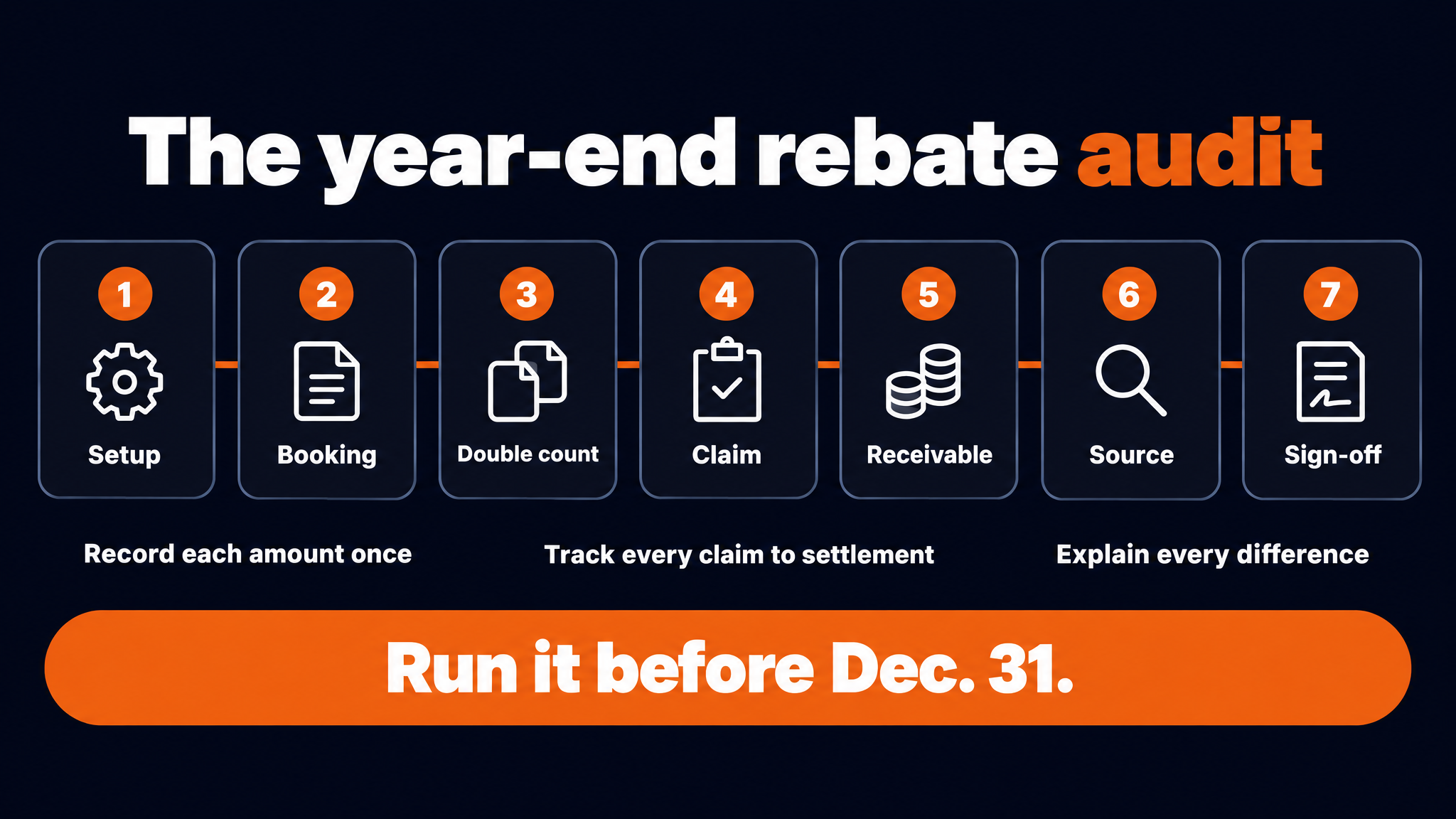
Year-end rebate audit
Line
What to check
Owner
1. Setup
On five rebate deals: customer cash or dealer cash, who does the OEM pay, and is each type set up the same way?
Controller
2. Booking
Is the amount actually applied to the deal recorded once, under the right treatment: customer rebate, dealer incentive or payment?
Controller
3. Double count
Is any amount counted twice: as a rebate credit and a down payment, or as reimbursed customer cash and dealer cash?
Sales manager
4. Claim
For money owed to the store, is each claim tracked through submission, approval and settlement? A rebate paid directly to the customer needs no store claim.
Sales manager and office
5. Receivable
Does it match the OEM statement? When a claim was paid, was the receivable cleared, not booked as new profit? Research anything over 30 days old.
Controller
6. Source
Is each number a desked estimate or the finalized DMS result, and on which commission or pack basis? Can you explain the difference?
GM
7. Sign-off
Who outside sales reviews deals before they are final?
Owner
Quick answers
Does passing dealer cash to the customer reduce gross?
Relative to keeping it, yes. Dealer cash raises gross when it is recognized once, and passing all of it on offsets that benefit. The deal should not read as a loss because the incentive was left off.
How long does a dealer have to claim an OEM rebate?
Each program sets its own deadline. KYMCO’s year-end coupons must be redeemed and claimed by Dec. 31. File early.
What is a factory receivable?
It is the balance the manufacturer owes the store for rebates, incentives and holdback. A Powersports Business dealer-consultant column (Aug. 10, 2017) put it plainly: “Rebates and incentives need to be treated like cash.” A rebate paid directly to the customer is not a factory receivable.
Do this this week
Verify the eligible incentive and its payment recipient. Record the amount actually applied to the deal once, using the correct customer-rebate, dealer-incentive or payment treatment. Track claims owed to the dealership through submission, approval and settlement. A rebate paid directly to the customer is not automatically a factory receivable for the store. When an accrued claim is paid, clear the receivable rather than creating another profit credit.
At finalization, reconcile the desking calculation to the final DMS result. Use the finalized DMS financial results as your reporting reference, and keep the original desk inputs and calculated gross for comparison and troubleshooting. Do not overwrite the record of how the deal was desked. Where a report uses a different commission, pack or trade value basis, show why the figures differ rather than forcing every report to one unexplained number.
When this doesn’t apply
A discount the store funds itself, with no OEM money behind it, really does reduce gross. Book it as a discount. If your DMS or your accountant fixes the method, follow theirs. This is not accounting advice; your accountant decides how your store books OEM money.
Where ODL fits
ODL helps dealers compare the economics of a desked deal with the final DMS result. We are updating how the ODL platform distinguishes customer rebates from dealer incentives, reflects genuine dealer cash once, and keeps ODL’s own calculations separate from the final DMS financial values for reconciliation. This work is in progress.
See how one connected deal flow helps keep the desk, F&I and reporting on the same deal record. Talk to an ODL Expert or call (877) 421-0135.
About the author
Param Ramakrishnan is CEO of One Dealer Lane, where he leads strategy, product development and operations. He previously held leadership roles at AppOne, Wolters Kluwer, Reynolds & Reynolds and A2Z.
Sources
- Powersports Business, “KYMCO launches year-end flooring extensions, ATV retail incentives” (Oct. 28, 2026)
- Powersports Business, Forrest Flinn, “Dealership ticking time bombs: Using your DMS to manage your rebates before they blow up!” (Nov. 8, 2019)
- Powersports Business, dealer-consultant column, “OEM rebates and incentive: Time bombs that could cost you” (Aug. 10, 2017)
- Yamaha Motorsports, “Try Then Buy” demo incentive registration (program closed May 30, 2026; viewed Nov. 18, 2026)
Back to Top
Get more from every deal
Sign up for a free trial and start driving higher gross this month. No commitment, just results.
(877) 421-0135