Back
The $191,000 Tax Every Powersports Dealer Is Paying — And Doesn’t See
By Param Ramakrishnan, CEO, One Dealer Lane • ~9 minute read
June 8, 2026
Share:

Key takeaways
- Knowledge workers switch apps roughly 1,200 times a day and lose about 4 hours every week just re-orienting after each switch — about 9% of total working time (Harvard Business Review).
- A typical powersports F&I manager juggles 10–15+ logins per day across DMS, desking, lender portals, product providers, and OEM tools.
- Translated into dealer math, that toggle penalty costs a 300–350-unit store about $40,000 a year, a 600-unit store about $86,000 a year, and a 1,500-unit store about $191,000 a year in pure loaded labor — before a single deal you didn’t close.
- Cox Automotive reports 62% of dealers run multiple disconnected retailing tools and 83% admit customers repeat steps in-store because the tools don’t talk.
- Dealers consolidating onto a unified workflow are cutting F&I headcount in half and shrinking long F&I waits from 59% of deals down to 37% (CDK).
A 1,500-unit powersports dealership burns roughly $191,000 a year in pure labor cost letting its BDC, sales, and F&I teams click between disconnected software — and that figure comes straight from translating Harvard Business Review’s Toggle Tax research into the headcount and pay scales of an average powersports rooftop. It shows up nowhere on the P&L, because it’s buried inside every payroll line. But it’s real, it’s measurable, and it’s growing. Here’s how the math works — and what the dealers shrinking it are doing differently.
What is the Toggle Tax — and why dealers feel it harder than most?
The Toggle Tax is the measurable productivity and cognitive cost of constantly switching between digital tools. Harvard Business Review’s 2022 analysis of nearly 20 million Microsoft logs found that knowledge workers do this on a scale most leaders never see.
Knowledge workers switch between applications roughly 1,200 times per day.” — Harvard Business Review (Murty, Dadlani, Das), 2022
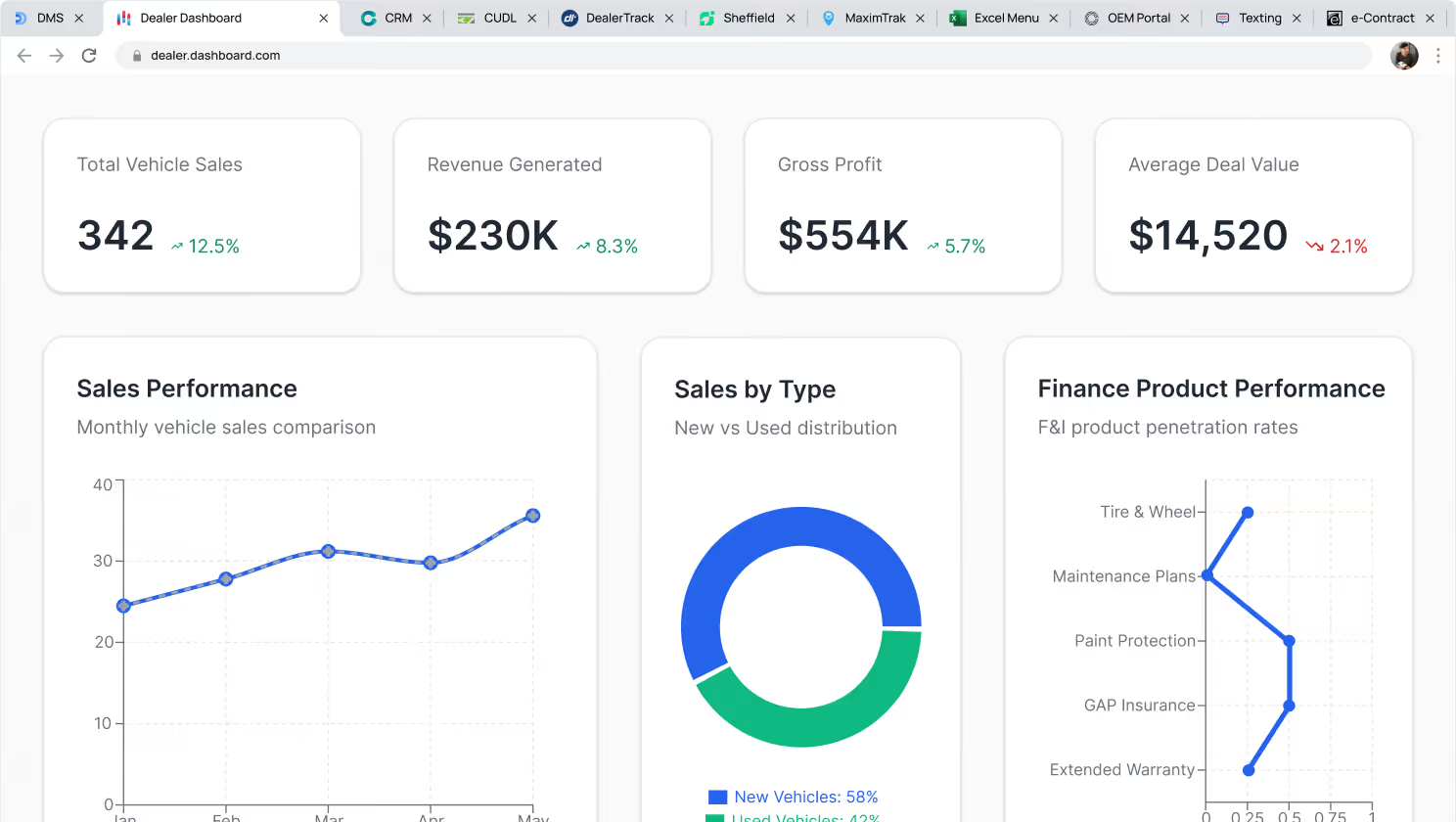
That number sounds suspicious until you sit next to an F&I manager for an hour. A single deal can touch a CRM, the DMS deal jacket, a desking and menu tool, three to six lender portals, one-contracting platform, a product-provider site, and the texting tool the customer just replied on — and the manager bounces between them dozens of times before a contract is signed.
Application switching alone consumes nearly four hours per week — about 9% of total working time — spent simply re-orienting after each switch.” — Harvard Business Review,2022
The cost isn’t the click. It’s the recovery. Qatalog and Cornell’s Ellis Idea Lab measured that workers need an average of 9 to 10 minutes to fully regain productive flow after every switch. Gloria Mark’s long-running research at UC Irvine puts the recovery cost even higher — about 23 minutes to fully refocus after an interruption, even a brief one. And Sophie Leroy’s University of Minnesota work explains why a “quick check” is never quick:
When people switch tasks, part of their attention remains stuck on the previous task, reducing performance on the next one.” — Sophie Leroy, University of Minnesota, 2009
That residue is the silent killer. It’s why your top closer can’t remember the customer’s trade payoff thirty seconds after looking it up — and why three tabs later, they’re re-pulling it. The American Psychological Association estimates that what most people call multitasking is rapid task-switching, and that it can reduce effective productivity by up to 40%. Asana’s Anatomy of Work Index found knowledge workers now use about ten applications a day. A powersports F&I manager runs higher than that before lunch.
How many logins does your team actually juggle in a day?
More than most principals realize. We mapped the typical stack at single-rooftop powersports dealers across the country, cross-referenced with Cox Automotive’s 2024 Digitization Study, CDK’s Friction Points data, and on-the-ground feedback from our customers. The pattern is consistent:
Follow the deal up the ladder and the logins compound. A lead lands with a BDC rep (many 300–350-unit stores don’t have one, so the sales floor absorbs it), moves to a sales associate, gets structured by a sales manager, and lands with the F&I manager — with a separate F&I director layered on only at the largest stores (3,000+ annual units). Sitting above all of them, the general manager watches dashboards, reports, and the daily “Daily Docs” — which, at virtually every store today, are still rebuilt by hand in spreadsheets pulled from systems that don’t talk to each other.
The F&I desk is where the toggle math gets ugly fast. A single deal often starts in the DMS, gets re-keyed into an Excel-based or standalone menu tool so the manager can build the customer presentation, then has to be manually exported back into the DMS once products are selected. That’s the same deal data entered, copied, and reconciled across three systems before a contract is even printed — and it happens on every car.
Cox’s 2024 Digitization of Car Buying Study put hard numbers on what dealers have been saying for years:
62% of dealers use multiple disconnected retailing tools, and 83% acknowledge customers repeat steps in-store because of inconsistent online data.” — Cox Automotive, 2024 Digitization of Car Buying Study
The dollar math: what the Toggle Tax actually costs a powersports dealer
This is the part most dealers haven’t run on themselves. The math is simple once you accept HBR’s baseline: knowledge workers lose about 9% of paid time to context-switching. Multiply that by your loaded payroll for variable-ops roles, and the leak appears. We modeled three stores using the most defensible 2024–2026 compensation ranges (PayScale, Glassdoor, Salary.com, ZipRecruiterfor BDC, sales, sales manager, and F&I roles, loaded at 1.3x for benefit sand payroll tax):
A few things to note about this table. First, it’s conservative. We used ablended FTE comp lower than what most stores actually pay their best closers —if your average F&I manager runs at $130K loaded, your number is bigger, not smaller. Second, the 9% figure is cross-industry; powersports dealers run more disconnected portals than the average HBR knowledge worker, so 9% is probably a floor, not a ceiling. Third, this is only the labor line. It doesn’t count the deals you didn’t close because the customer left, the lender approvals that timed out while a manager was hunting for a stip, or the F&I products that never got presented because the menu didn’t auto-populate.
McKinsey’s January 2025 auto-retail productivity analysis found that the industry has been stuck at 14 to 16 vehicles sold per employee per year for nearly adecade despite massive technology investment — and that every one-percent gain in sales productivity is worth roughly $500,000 in revenue at the average rooftop. The math is the same in powersports.
There is no magic bullet for the productivity challenges facing US auto retail. But leading dealers have shown that a more holistic approach to managing digitalization can reap dividends. In practice, this means moving away from pick-and-mix solutions and toward deeper integration.
— McKinsey & Company, January 23, 2025
What the Toggle Tax actually breaks beyond payroll
The labor leak is the easy number to defend. The real damage is downstream. Three things consistently break in high-toggle dealerships:
1. Deal velocity and customer drop-off
CDK’s Friction Points work found that dealerships consolidating onto integrated digital retailing workflows shrunk the share of deals with a 30-plus-minute F&I wait from 59% down to 37% — and cut F&I headcount from 4.4 to 2.2 employees per store in the process. The customers who didn’t wait are the ones who came back for parts, accessories, and the next bike.
2. F&I product penetration and PVR
When a menu doesn’t pre-load deal data from the desk and customer record, F&I managers default to a shorter pitch on fewer products. VisionAST’s Q2 2025 powersports benchmark showed F&I PVR up $32.77 quarter-over-quarter at top-quartile stores — with the gain explicitly tied to 0.5 more products per deal on average. A unified menu with no re-keying is the cheapest way to get there.
3. Staff retention
McKinsey pegs auto-retail turnover at 34% on average. The exit interviews almost never say “too many logins.” They say burnout, frustration, or “the systems don’t talk.” Same cause. Qatalog and Cornell’s 2021 work found that nearly halfof workers report that switching between too many tools makes them less productive and mentally exhausted. Replace an F&I manager and you’re writing a check for $25K–$50K in recruiting, ramp, and lost deals before the chair is warm again.

How are dealers actually fighting the Toggle Tax?
The dealers shrinking their toggle penalty aren’t ripping out every system. They’re doing four things, in order:
- Runan honest integration audit. List every login your BDC, sales, and F&I teams open in a normal Tuesday — and every report your GM rebuilds by hand. Mark every data hand-off that requires re-keying. The exercise alone is uncomfortable enough to drive change.
- Pick the deal record as your spine. One customer, one deal, one record — surfaced inside every tool the customer-facing team uses. The DMS deal jacket should be the single source of truth, not a downstream report.
- Consolidate logins, not necessarily tools. You don’t need fewer lenders; you need one workflow that submits to all of them. Same for product providers, OEM portals, and texting.
- Measure before-and-after on something visible. Pick one number — average time from desking to signed contract is a good one — and watch it for thirty days after every workflow change. Toggle Tax wins compound when the team sees them.
Dealers shouldn't have to manage inventory in multiple places
— Jason Lehman, CEO, Dealer Spike, Powersports Business, August 2025
None of this requires a forklift upgrade. It requires deciding that the cost of disconnected software is real, naming it, and then refusing to pay it any longer. The dealers we work with at One Dealer Lane usually find the first $30,000 to $50,000 of recovered labor in the first-quarter — not because they swapped out their DMS, but because they stopped re-keying deals across five screens.
Frequently asked questions
What exactly is the “Toggle Tax”?
It’s the measurable productivity and cognitive cost of constantly switching between digital tools. Harvard Business Review estimates it consumes about 9% of a knowledge worker’s time — roughly four hours every week — spent re-orienting after each switch.
How many software tools does a typical powersports dealership run?
Most single-rooftop dealers run between 8 and 15 customer-facing systems daily across the variable-ops team: a DMS, a sales CRM, a desking and menu tool, three to six lender portals, OEM portals, a texting platform, an e-contracting tool, plus the manual spreadsheets a sales manager and GM rebuild by hand ford aily reporting. Asana’s research shows that knowledge workers across industries now juggle about ten apps a day; F&I managers in powersports routinely exceed that.
What does the Toggle Tax cost my dealership in real dollars?
Apply HBR’s 9% time-loss figure to your loaded payroll for variable-ops roles. A 300–350-unit store with six variable-ops employees at about $75,000 loaded comp loses roughly $40,000 a year. A 600-unit store with twelve variable-ops employees at roughly $80,000 loaded loses about $86,000. A 1,500-unit store with twenty-five at $85,000 loaded loses about $191,000. That’s pure labor leak — it doesn’t count deferred deals, missed lender approvals, or burnt-out F&I managers walking out the door.
How do I actually reduce it without ripping out every system?
Start with an integration audit: list every login your BDC, sales, and F&I teams touch in a day, then mark the data hand-offs that require copy-paste or re-keying. The CDK Friction Points study found that consolidating tools cut F&I headcount almost in half and shrunk the share of deals with 30-plus minute F&I waits from 59% to 37%. Most dealers don’t need fewer tools — they need fewer login sand one shared deal record.
The bottom line
Every powersports dealer is paying the Toggle Tax. Most aren’t measuring it. The ones who are have figured out that an extra four hours back per employee, per week, is the cheapest BDC, sales, and F&I hire they’ll ever make. The next bike you sell shouldn’t require eleven logins to deliver.
See what your team’s time is actually worth.
Request a 20-minute workflow audit with One Dealer Lane. We’ll walk through your stack, map the toggle hotspots, and show you the dollar number for your store — free, no commitment.
→ Visit onedealerlane.com • Call (877) 421-0135
About the author
Param Ramakrishnan is the CEO of One Dealer Lane. He works with powersports dealers of every size — from single-rooftop independents to large dealer groups like Sonic Powersports with 15+ stores — on how to leverage modern technology and AI tools to streamline their variable-ops departments. He writes about dealer operations, F&I product penetration, and what it actually takes to consolidate a fragmented BDC, sales, and F&I workflow into a single deal record.
Sources and further reading
- Harvard Business Review (Murty, Dadlani, Das), “How Much Time and Energy Do We Waste Toggling Between Applications?” 2022.
- Qatalogand Cornell University Ellis Idea Lab, “Killing Time at Work” study, 2021.
- Sophie Leroy, “Why Is It So Hard to Do My Work? The Challenge of Attention Residue When Switching Between Work Tasks,” University of Minnesota, 2009.
- Gloria Mark, University of California, Irvine, “The Cost of Interrupted Work,” ACMCHI.
- American Psychological Association, “Multitasking: Switching Costs.”
- Asana, Anatomy of Work Index.
- Cox Automotive, 2024 Digitization of Car Buying Study, released June 25, 2025. https://www.coxautoinc.com/market-insights/2024-digitization-of-car-buying-study/
- McKinsey & Company, “Boosting auto sales productivity: A playbook for excellence, January 23, 2025. https://www.mckinsey.com/industries/automotive-and-assembly/our-insights/boosting-auto-sales-productivity-a-playbook-for-excellence
- CDK Global, Friction Points Study 2024. https://www.cdkglobal.com
- VisionAST Powersports IndustryBenchmarks, Q1 – Q3 2025. https://www.visionast.com
- Powersports Business, “Dealer Spike +Blackpurl 2 integration,” August 19, 2025. https://powersportsbusiness.com
- PayScale, Glassdoor, Salary.com, ZipRecruiter — powersports BDC, sales, sales manager,and F&I compensation data, 2024–2026.
- One Dealer Lane, “The hidden reason your F&I is losing time (and profit),” October 29, 2025.
Back to Top
Get more from every deal
Sign up for a free trial and start driving higher gross this month. No commitment, just results.
(877) 421-0135